稿
Character Story & Explanation
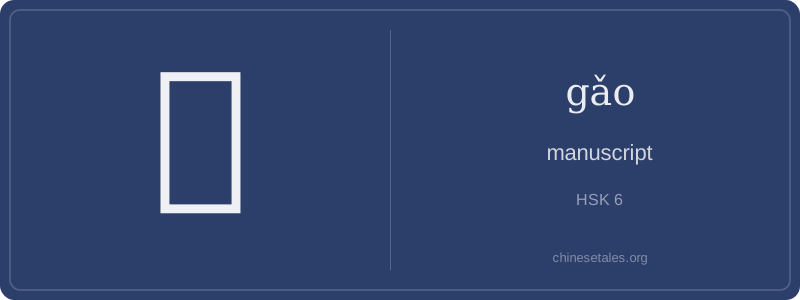
The earliest form of 稿 appears in bronze inscriptions as a combination of 禾 (grain stalks, representing growth and sustenance) and 高 (gāo, ‘high’ or ‘elevated’, later simplified to 告 in modern script). In oracle bone script, it wasn’t pictographic per se, but the bronze version clearly paired 禾 with a phonetic component signaling elevation — suggesting ‘something raised up from the soil of thought’. Over centuries, the top evolved into the modern 告 (gào), while the bottom remained 禾, and strokes condensed: the original 17-stroke variant streamlined to today’s clean 15 strokes — each line now echoing the careful structure of a well-organized document.
This visual evolution mirrors its semantic journey: from ancient agrarian metaphors — grain as nourishment, writing as mental harvest — to Warring States texts like the *Zuo Zhuan*, where 稿 referred to ‘prepared statements’ delivered by envoys. By the Tang dynasty, it solidified as ‘written draft’, especially in official and literary contexts. The 禾 radical isn’t decorative: it roots the idea of writing in cultivation — just as grain requires tending, a manuscript demands nurturing, pruning, and seasonal patience. Even today, editors say ‘培育稿件’ (bèiyù gǎojiàn, ‘cultivate manuscripts’), preserving that ancient link between field and page.
At its heart, 稿 (gǎo) is all about the *preliminary* — not the final product, but the raw, editable, often messy stage of creation: a manuscript, draft, or outline. It carries an inherent sense of work-in-progress, effort, and intellectual labor — think scribbled notes, marked-up pages, or a Word doc with ‘[INSERT QUOTE HERE]’ still blinking. Unlike generic words for ‘text’ like 文 (wén), 稿 implies authorship, revision, and intentionality.
Grammatically, 稿 is almost always a noun and appears in compound nouns (e.g., 讲稿, 草稿). It rarely stands alone — you’d say 交稿 (jiāo gǎo, 'submit the draft'), not just *交稿* as a verb phrase without context. Learners sometimes wrongly treat it as a verb ('to draft') or confuse it with abstract concepts like ‘idea’ — but 稿 is always tangible: something written, held, edited, or filed. You submit a 稿, revise a 稿, burn a 稿 — it’s physical in spirit, even in the digital age.
Culturally, 稿 evokes the Confucian reverence for writing as moral and scholarly labor — hence its radical 禾 (grain), symbolizing nourishment and cultivation. A common mistake? Using 稿 where 程序 (chéngxù, 'procedure') or 方案 (fāng'àn, 'plan') fits better — 稿 must involve *written expression*, not just planning. Also, note that while English says ‘a draft’, Chinese often omits the measure word: 我改了三稿 (wǒ gǎi le sān gǎo) — literally ‘I revised three manuscripts’, not ‘three drafts’.