窜
Character Story & Explanation
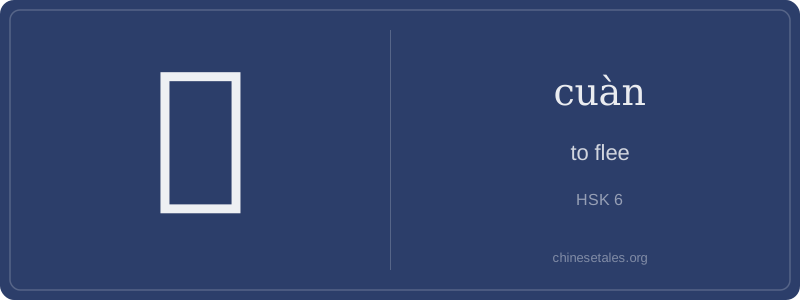
The earliest form of 窜 appears in bronze inscriptions as a pictograph combining two elements: a roof-like ‘cave’ (穴, the radical) above a simplified figure of a person (in oracle bone script, resembling a crouching man with arms raised). Over time, the person evolved into the lower component — 串 (chuàn), originally depicting threaded shells or objects, but here repurposed phonetically and visually to suggest *something moving rapidly through a linear path*, like beads sliding down a string — reinforcing the idea of swift passage *through* a confined space.
By the Warring States period, 窜 solidified into its modern structure: 穴 + 串. Classical texts like the Zuo Zhuan use it to describe fugitives ‘dashing into mountain grottos’ (窜入岩穴), emphasizing both physical enclosure and moral rupture. The visual logic is brilliant: the upper ‘cave’ sets the scene of concealment; the lower ‘string-of-beads’ suggests rapid, unbroken motion — together, they evoke *a body hurtling headlong into darkness*. This isn’t quiet hiding — it’s kinetic, urgent, and slightly undignified.
Imagine a panicked official during the Tang Dynasty, sleeves flapping, scrambling headfirst into a narrow cave entrance — not to hide, but to *vanish* from imperial wrath. That’s 窜 (cuàn): not just ‘flee’, but a sudden, desperate, often downward or concealed escape — like a rat darting into a hole. It carries urgency, shame, or illegitimacy: you don’t 窜 from a party; you 窜 from arrest, scandal, or battlefield collapse. It’s inherently directional and spatial — always *into*, *through*, or *out of* confined spaces.
Grammatically, 窜 is almost always transitive and action-focused: it takes an object (e.g., 窜入山林, 窜逃境外) and rarely stands alone. You won’t say ‘he cuàn’ — you’ll say ‘he cuàn into the woods’ (窜入树林). Unlike 跑 (pǎo, neutral ‘run’) or 逃 (táo, general ‘escape’), 窜 implies disarray, loss of dignity, and spatial intrusion — often with negative connotations (e.g., 窜改文件 means ‘to tamper with documents’, evoking sneaky, under-the-surface alteration).
Culturally, 窜 appears in historical texts describing traitors, rebels, or disgraced ministers vanishing into mountains or caves — never heroic retreats. Learners mistakenly use it for everyday fleeing (e.g., ‘I had to 窜 when my boss walked in’ — wrong! Use 跑 or 偷溜). Also beware: it’s *not* used for migration (移民), exile (流放), or legal departure — those lack its visceral, chaotic energy.