窃
Character Story & Explanation
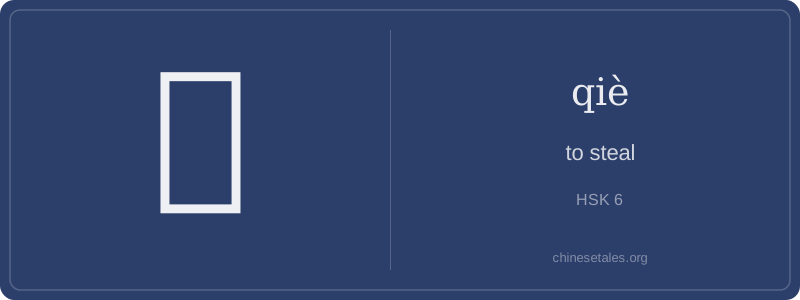
The earliest form of 窃 appears in Warring States bamboo texts as a compound: a ‘cave’ (穴) radical on top, and below, a simplified depiction of a person (乚-like curve) reaching *into* that cavity — not to enter, but to extract something unseen. Over centuries, the lower part evolved from a crouching figure into the modern ‘切’ component (which itself means ‘to cut’, suggesting precision and incision — as if slicing away property unnoticed). The nine strokes crystallized by the Han dynasty: first the roof-like 穴 (5 strokes), then the sharp, downward-cutting stroke sequence of 切 (4 strokes) beneath it — a visual pun on stealth-as-surgery.
This ‘cave + cut’ imagery persisted powerfully in classical usage. In the Records of the Grand Historian, Sima Qian uses 窃 to describe ministers who ‘secretly altered imperial edicts’ — not with force, but by slipping revisions into the margins like whispers in a dark chamber. Even today, the character’s shape whispers its meaning: theft isn’t brute force; it’s the quiet breach of boundaries — entering where you’re not seen, cutting away what isn’t yours, all within the hollow space of discretion.
At its core, 窃 isn’t just ‘to steal’ — it’s the stealthy, almost ghostly act of taking something *without being seen*. Unlike 偷 (tōu), which is colloquial and neutral, 窃 carries literary weight, moral gravity, and a whiff of classical censure. It’s the verb you’d find in a Ming dynasty legal document or a modern editorial condemning intellectual piracy — never in a casual chat about your roommate ‘borrowing’ your snacks without asking.
Grammatically, 窃 functions mainly as a verb (e.g., 窃取 information) or, more elegantly, as a prefix meaning ‘secretly’ or ‘underhandedly’ — like 窃笑 (qiè xiào, ‘to smirk inwardly’) or 窃喜 (qiè xǐ, ‘to secretly rejoice’). Crucially, it’s rarely used alone: you won’t hear ‘他窃了钱’; instead, it appears in compounds or with modifiers (如:涉嫌窃取, 被控窃用). Learners often overuse it trying to sound formal — but native speakers reserve it for contexts where intention, concealment, and ethical violation are central.
Culturally, 窃 evokes Confucian disdain for hidden wrongdoing — it’s not just illegal, it’s *shameful*. A classic trap? Confusing it with the homophone 切 (qiē/qiè, ‘to cut’ or ‘earnestly’), especially in handwriting. Also, note its radical 穴 (cave/hole): this isn’t random — it signals that the act happens *in hiding*, like slipping through a crack in the wall. That visual metaphor — theft as something done from the shadows, through an opening — still shapes how Chinese speakers conceptualize secrecy and violation today.