筋
Character Story & Explanation
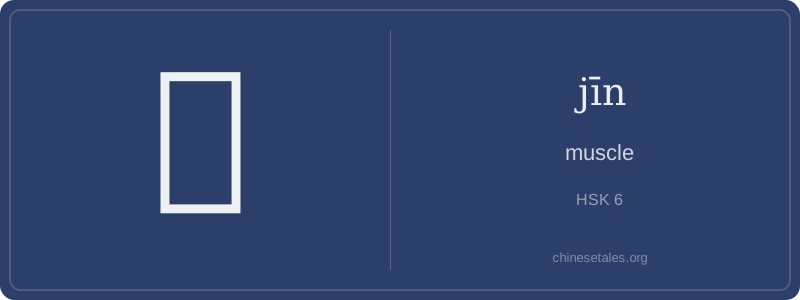
The earliest form of 筋 appears in bronze inscriptions as a composite pictograph: a simplified drawing of a tendon or sinew (resembling twisted fibers) wrapped around a bone or joint, with the bamboo radical ⺮ added later — not because tendons grow from bamboo, but because ancient scribes associated its resilient, flexible toughness with bamboo’s structural integrity. Over centuries, the sinew element evolved into the right-side component ⺼ (a variant of 月 meaning ‘flesh’), while the left side solidified as ⺮ (bamboo), giving us today’s 12-stroke structure — a visual metaphor frozen in ink: *bamboo-like toughness in the flesh*.
This duality shaped its semantic journey: in the *Zuo Zhuan*, 筋 described literal tendons used in bowstrings — prized for their elasticity and endurance. By the Han dynasty, it expanded into moral philosophy: Mencius wrote of ‘大丈夫’ whose ‘筋骨’ (jīn gǔ — sinews and bones) symbolize unyielding virtue. Even today, when someone says ‘他很有筋道’, they’re not praising their biceps — they mean their handmade noodles have perfect chewy resilience, echoing that ancient link between physical tensile quality and admirable human tenacity.
At first glance, 筋 (jīn) means 'muscle' — but in Chinese thinking, it’s never *just* anatomy. It’s the hidden architecture of strength, resilience, and even moral fiber: think of the idiom '宁折不弯' (would rather snap than bend), where 筋 evokes the tough, sinewy resistance inside bamboo or a person’s character. Unlike English ‘muscle’, which can be purely physical (‘arm muscle’) or metaphorical (‘political muscle’), 筋 carries an inherent sense of *tensile integrity* — it’s what holds things together under tension, whether in the body, a bowstring, or a well-structured argument.
Grammatically, 筋 rarely stands alone as a noun in everyday speech (you’d say 肌肉 for ‘skeletal muscle’); instead, it thrives in compounds and idioms. You’ll hear it in verbs like 筋疲力尽 (jīn pí lì jìn — ‘sinews exhausted, strength spent’), where 筋 is part of an inseparable four-character unit — not a standalone subject. Learners often mistakenly use 筋 as a countable noun like ‘a muscle’, but native speakers almost never say *one* 筋; it’s always collective, abstract, or embedded.
Culturally, 筋 reflects traditional Chinese medicine’s holistic view: it’s one of the ‘five tissues’ (五体) linked to the liver, governing movement and tendons — so stiffness in the neck isn’t just ‘tight muscles’, it’s ‘liver qi stagnation affecting the jīn’. A classic mistake? Using 筋 where 肌肉 fits better — e.g., saying *这个动作锻炼筋* sounds archaic or poetic, not gym-class natural. Reserve 筋 for literary, medical, or idiomatic weight — like calling your Wi-Fi connection ‘the nervous system of the house’ instead of just ‘the router’.