筛
Character Story & Explanation
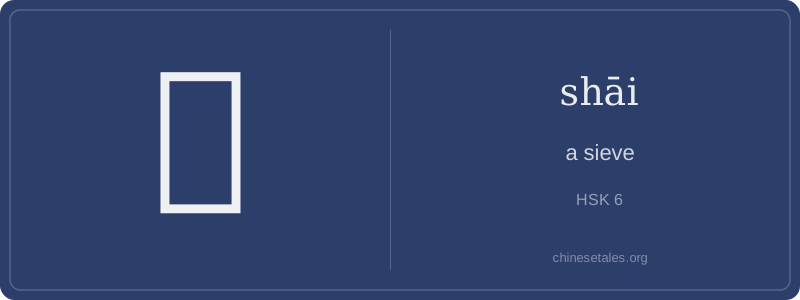
The earliest form of 筛 appears in Han dynasty bamboo slips as a phono-semantic compound: the top ⺮ (bamboo) radical hints at the material (ancient sieves were woven from split bamboo), while the bottom 帅 (shuài, originally meaning ‘to lead’ or ‘command’) provided sound—and subtly, meaning. 帅 wasn’t just phonetic; in early usage, it carried connotations of selection and leadership, as in ‘leading troops’ or ‘choosing the best’. Over centuries, the bottom evolved from 帅 to its simplified modern shape, losing the ‘ten thousand’ (萬) component but keeping the decisive stroke order that mimics the downward motion of sifting.
By the Tang dynasty, 筛 had shifted fully from physical sifting to abstract filtering—Li Bai wrote of ‘sifting moonlight through willow branches’, using it poetically for selective perception. The character’s structure itself enacts its function: the bamboo top forms a grid-like frame, while the lower part’s angular strokes suggest the vigorous shaking motion required to separate fine from coarse. Even today, when Chinese say ‘筛一遍’, they evoke not just mechanical action—but the mindful labor of judgment.
At its heart, 筛 (shāi) isn’t just a kitchen tool—it’s a verb of discernment. In Chinese, to ‘sieve’ is to separate the essential from the extraneous, and this metaphor permeates everything from job recruitment (筛选简历, ‘screening resumes’) to scientific research (筛选基因, ‘screening genes’). Unlike English, where ‘sieve’ is mostly noun-based, Chinese treats 筛 as an active, often bureaucratic or technical verb—quietly reflecting how deeply value judgment is baked into daily language.
Grammatically, 筛 is almost always transitive and frequently appears in compound verbs like 筛选 (shāixuǎn, ‘to screen/select’) or 筛掉 (shāi diào, ‘to filter out’). Learners often mistakenly use it intransitively (e.g., *‘The data筛了’), but it always needs an object: you don’t ‘sieve’—you ‘sieve something’. Also, avoid confusing it with passive constructions; 筛 is emphatically agentive—you’re doing the choosing, not waiting for fate.
Culturally, 筛 carries a subtle weight of authority and responsibility. In classical texts like the *Zuo Zhuan*, officials were said to ‘sieve talent’ (甄才篩士) — a duty implying wisdom, fairness, and consequence. Modern learners sometimes overuse it in casual speech (e.g., saying ‘我筛一下朋友’ instead of ‘我看看朋友’), sounding oddly clinical or even elitist. Remember: 筛 implies intentionality, effort, and stakes—not just browsing.