粥
Character Story & Explanation
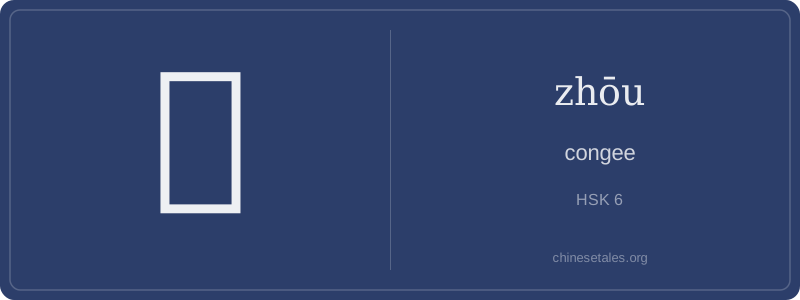
The earliest form of 粥 appears in bronze inscriptions (c. 1000 BCE) as a composite: 米 (rice grains) + 弓 (bow-shaped curve, later stylized into 丶 and 丸-like strokes) — representing rice boiled until it swells, softens, and curls like a bow under heat. Over centuries, the top evolved from a pictorial rice cluster into the standard 米 radical, while the bottom simplified from complex boiling-steam glyphs into the elegant, flowing 2–3–2–2–3 stroke sequence we see today: 丶 (dot), ㇇ (horizontal hook), 丿 (left-falling stroke), 丶 (dot), (down-right corner), 丶 (final dot). Every stroke evokes simmering motion — no rigid angles, all gentle curves.
This visual rhythm mirrors its semantic journey: from early texts like the *Rites of Zhou*, where 粥 denoted ritual grain offerings cooked to 'soft submission', to Tang dynasty poetry praising its restorative power for scholars burning midnight oil. By the Song era, it appeared in medical manuals as the first prescribed food after illness — cementing its identity as 'nourishment that yields'. The character’s lack of sharp edges isn’t accidental: it literally cannot be drawn with harsh lines, reinforcing its cultural role as food that bends, soothes, and surrenders to care.
At its heart, 粥 (zhōu) isn’t just ‘rice porridge’ — it’s liquid comfort, medicinal warmth, and cultural humility in a bowl. In Chinese, it carries softness and care: you don’t just *eat* 粥; you *drink* it (喝粥), *cook* it slowly (熬粥), or *recover with* it (病后喝粥). It’s rarely used as a countable noun like 'a congee' — instead, it’s mass-noun, unquantified: 一碗粥 (a bowl of congee), not *一粥*. This reflects how Chinese treats food-as-substance rather than food-as-object.
Grammatically, 粥 almost never stands alone as a subject without measure words or context. Learners often mistakenly say *我吃粥* without specifying quantity or condition — but native speakers naturally add nuance: *今天胃口不好,只喝了一小碗粥* ('My appetite is poor today — I only drank a small bowl'). Also, note that 粥 is rarely pluralized or modified by adjectives directly; instead, descriptors come before (e.g., 白粥, 皮蛋瘦肉粥), making the compound the functional unit.
Culturally, 粥 is the ultimate 'food for humans at their most human': for babies, elders, patients, and even monks fasting — it’s the linguistic embodiment of ren (benevolence) made edible. A common learner trap? Using 粥 when they mean Western-style 'soup' (汤); while both are liquids, 汤 implies broth with solids, whereas 粥 is always grain-thickened and starchy. Confusing them can turn a hospitable meal into a confusing texture mismatch!