纹
Character Story & Explanation
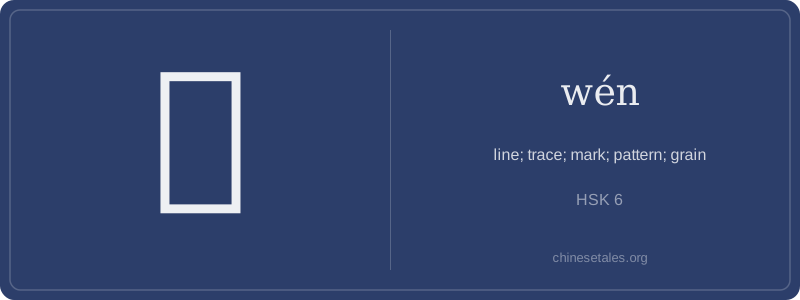
The earliest form of 纹 appears in Warring States bamboo slips as a stylized depiction of intertwined silk filaments — two parallel wavy lines (suggesting threads) crossed by a gentle curve, all enclosed within a frame-like element representing the loom or boundary of the weave. Over centuries, the framing element simplified into the left-side 纟 radical (three dots + two strokes, evoking twisted thread), while the right side evolved from a complex ‘wen’ phonetic component (文) into today’s simplified 文 — which, delightfully, also means ‘pattern’ or ‘culture’, creating a visual pun: ‘silk + pattern = pattern’.
This self-referential elegance deepened in usage: in the *Book of Rites*, 纹 referred to ritual embroidery on ceremonial robes — not mere decoration, but cosmological mapping, where each line mirrored celestial order. By the Tang dynasty, poets like Du Fu used 纹 to evoke melancholy subtlety: ‘the faint纹 of frost on the windowpane’ — a line so delicate it blurred the boundary between nature and human perception. The character’s enduring power lies in its duality: it names both the physical mark *and* the invisible logic behind its formation — the grammar of grain.
Picture a silk thread gently twisting — that’s the soul of 纹 (wén). Its radical 纟 (sī), meaning ‘silk’, isn’t just decorative: it anchors the character in the tactile world of texture, where patterns emerge not from paint or ink, but from the very weave of fabric, wood grain, or skin. In classical Chinese, 纹 described natural, fine, repeating lines — like ripples on water or the delicate whorls of a fingerprint — and today it retains that quiet, observational precision. It’s never loud or abstract; it’s always *there*, subtle but undeniable.
Grammatically, 纹 is almost always a noun — you don’t ‘verb’ a纹 — and it rarely stands alone. You’ll meet it in compounds like 皱纹 (zhòu wén, ‘wrinkle’) or 木纹 (mù wén, ‘wood grain’), or as the object of verbs like ‘show’, ‘reveal’, ‘follow’, or ‘carve’. Learners often mistakenly use it as a verb (e.g., *‘wén yī ge tú’* — nope!) or confuse it with abstract ‘design’ (that’s 图案, tú àn). Also, while English says ‘a pattern on the wall’, Chinese prefers 墙上的花纹 (qiáng shàng de huā wén) — literally ‘flower-pattern on the wall’ — because 纹 implies organic, inherent structure, not imposed decoration.
Culturally, 纹 carries quiet reverence: traditional jade carvers studied stone veins before cutting; calligraphers read the ‘spirit lines’ (气纹, qì wén) in brushstrokes; even fortune-tellers examine palm lines (掌纹, zhǎng wén) as living topography. A common slip? Using 纹 for ‘textile pattern’ in fashion contexts — better to say 花样 (huā yàng) or 图案. Remember: 纹 is what *grows*, *forms*, or *emerges* — not what’s printed or drawn.