缀
Character Story & Explanation
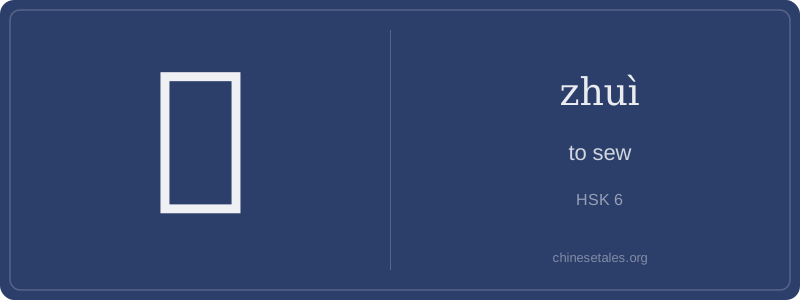
The earliest form of 缀 appears in bronze inscriptions as a compound: left side showed two twisted silk filaments (the ancient precursor to 纟), while the right side depicted a hand holding a needle piercing fabric — sometimes with a dangling thread or bead. Over centuries, the hand simplified into 辍 (chuò), then further stylized into 又 (yòu, ‘again’), and the needle-and-fabric morphed into the phonetic component 辍’s lower part, eventually crystallizing into today’s 又 + 几. The 11 strokes encode this evolution: three dots for silk (糹), then 又 (6 strokes), then 几 (2 strokes) — totaling 11, mirroring the precision of counted stitches.
By the Han dynasty, 缀 had expanded beyond tailoring: Sima Qian used 缀 in the Records of the Grand Historian to describe how historians ‘sew together’ fragmented accounts into coherent narratives — ‘zhuì shǐ’ (to compile history). This semantic leap — from physical sewing to intellectual weaving — cemented its role in formal discourse. Its visual rhythm (silk + repetition + support) mirrors its function: it doesn’t just connect — it *reinforces continuity*, whether in cloth, text, or thought.
Imagine a master tailor in Suzhou’s silk district, fingers flying as she zhuì tiny jade beads onto the hem of a bridal qipao — not just stitching thread, but weaving intention: each bead secured with deliberate, precise attachment. That’s 缀 (zhuì) — it’s never casual glueing or stapling; it’s intentional, often decorative or functional *joining*, usually by thread, but metaphorically extended to language, logic, or even emotion. It carries quiet craftsmanship: you don’t ‘add’ a clause haphazardly — you zhuì it, like attaching a delicate pendant.
Grammatically, 缀 is almost always transitive and formal — you’ll rarely hear it in spoken Mandarin outside literary or technical contexts. It pairs with objects like ‘words’, ‘sentences’, ‘ornaments’, or ‘details’. Note the trap: learners often reach for 缀 when they mean ‘to attach’ generally (like 贴 or 粘), but 缀 implies *thread-based* or *structural linkage* — think ‘sew on’, ‘append’, ‘interweave’. You 缀 a footnote to an essay, not a photo to a fridge.
Culturally, 缀 echoes classical aesthetics: in poetry, 缀句 (zhuì jù) means ‘stringing phrases together’ — not just writing, but artful composition. Mistake it for 追 (zhuī, ‘to chase’) or 坠 (zhuì, homophone meaning ‘to fall’), and your sentence collapses from elegance into chaos. Also beware tone: zhuì (4th) ≠ zhuī (1st) — one sews, the other pursues.