缔
Character Story & Explanation
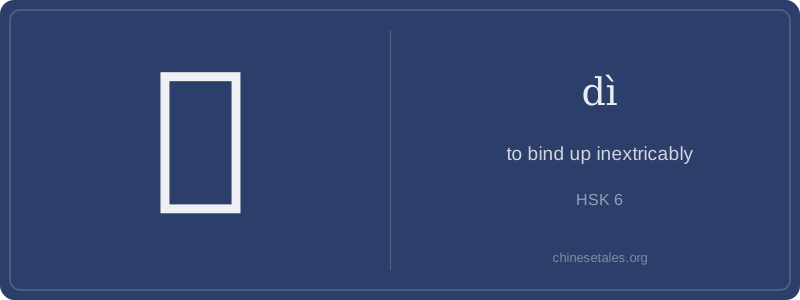
The earliest form of 缔 appears on Warring States bamboo slips as a composite glyph: left side 糸 (a stylized skein of silk threads), right side 帝 (emperor, originally a sacrificial altar with upright stakes). Visually, it depicted threads ceremonially knotted *at the imperial altar*—not random binding, but sacred, sovereign-grade fastening. Over centuries, the right side simplified from 帝’s full oracle bone form (+巾) to today’s 帝, while the left 糸 shrank to 纟 (the ‘silk’ radical), preserving the textile ritual core. The 12 strokes map perfectly: 3 for 纟, 9 for 帝—no stroke wasted.
This altar-thread imagery birthed its semantic gravity. In the *Book of Rites*, 缔 is used specifically for ‘binding alliances through shared sacrifice’, where the knot wasn’t decorative—it was a metaphysical tether. By the Tang dynasty, poets like Du Fu used 缔造 metaphorically: ‘Heaven 缔造 this landscape’—implying divine craftsmanship, not accidental formation. The character’s visual tension—delicate silk versus imperial authority—mirrors its meaning: fragile materials wielded with absolute, unbreakable intent.
Think of 缔 like signing a blood oath in medieval Europe—not just a handshake, but a vow woven into your very DNA. Its core meaning isn’t mere ‘to bind’ (like tying shoelaces), but to forge an *inescapable, solemn, irreversible connection*: treaties, alliances, marriages, or fates sealed with ritual gravity. In Chinese, it’s almost always transitive and formal—never used for physical knots or casual promises. You’ll see it only with weighty nouns: 缔结盟约 (to conclude an alliance), 缔造新中国 (to found the People’s Republic)—never *缔一个结* (that’s 打结).
Grammatically, 缔 appears almost exclusively in compound verbs (缔结, 缔造, 缔定), never standalone. Learners often mistakenly use it where 签 (to sign) or 建立 (to establish) would be natural—e.g., saying *缔合同* instead of 签合同. That error sounds like swearing a sacred covenant over a grocery receipt! Also, it’s never used in progressive aspect (*正在缔*) or past-perfect (*已经缔了*); its power lies in completed, consequential action.
Culturally, 缔 carries Confucian and diplomatic resonance: it implies mutual obligation, moral permanence, and historical consequence. Ancient texts like the *Zuo Zhuan* describe feudal lords 缔盟 (binding alliances) under sacrificial oxen—a ritual so binding that breaking it invited cosmic retribution. Modern usage retains that aura: even in corporate press releases, 缔结战略合作 signals ironclad commitment, not just paperwork. Mistake this for a synonym of 连接? You’ve just upgraded a Wi-Fi link to a dynastic marriage.