缝
Character Story & Explanation
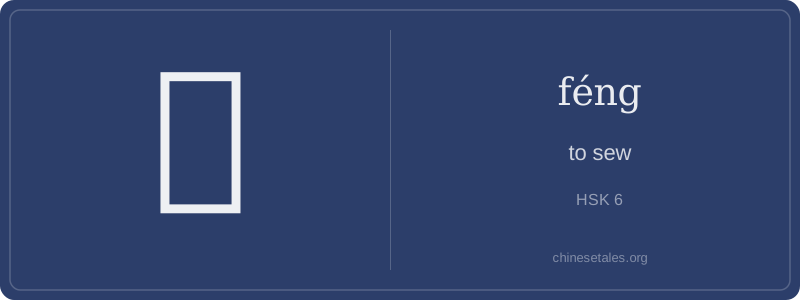
The earliest form of 缝 appears in seal script, where the left side 纟 (sī) — a stylized skein of silk thread — anchors the character visually and semantically. The right side, 雷 (léi), originally depicted thunderclouds with raindrops, but here it’s a phonetic component (not meaning ‘thunder’!). Over centuries, 雷 simplified to 彭 (péng) then further to today’s 逢 (féng), preserving the sound while losing its pictorial thunder. By the Han dynasty, the modern structure — 纟 + 逢 — stabilized: thirteen strokes tracing the rhythm of needle, thread, and hand movement.
This character’s semantic journey is subtle but profound: from concrete textile labor (‘stitching cloth’) it extended metaphorically to ‘mending relationships’ (e.g., 缝合感情, ‘stitch together feelings’) and even ‘bridging divides’ in political discourse. In the *Zuo Zhuan*, a 5th-century BCE chronicle, 缝 appears in descriptions of ritual robes — garments whose flawless seams signaled moral integrity. Visually, those 13 strokes mimic the back-and-forth pull of a needle: the four dots in 逢 echo stitch points; the vertical stroke of 纟 is the taut thread itself — a beautiful fusion of sound, shape, and action.
At its heart, 缝 (féng) isn’t just ‘to sew’ — it’s the quiet, precise act of drawing thread through fabric to join, mend, or create something whole. Think of a tailor leaning over a garment, needle in hand: that focused, intentional motion is baked into the character’s energy. It’s a verb that implies care, continuity, and restoration — not just stitching cloth, but bridging gaps.
Grammatically, 缝 behaves like a transitive verb requiring an object (e.g., 缝衣服, 缝扣子), and it often appears in resultative complements like 缝好 (fènghǎo, 'sew well/finish sewing') or passive constructions with 被 (e.g., 扣子被缝歪了, 'the button was sewn crooked'). A common learner trap? Forgetting that 缝 never stands alone as a noun meaning 'seam' — that’s 缝 (fèng), a homograph with different tone and meaning! Confusing féng and fèng mid-sentence can turn 'She sewed the dress' into 'She seam-ed the dress' — nonsensical and hilarious.
Culturally, 缝 carries warmth and domestic virtue: in classical texts like the *Book of Rites*, meticulous mending symbolized frugality and respect for resources. Today, when grandparents say 我来帮你缝一缝, it’s less about thread and more about quiet love — a tiny act of holding things together. That emotional resonance is why this HSK 6 verb feels deeply human, not technical.