缴
Character Story & Explanation
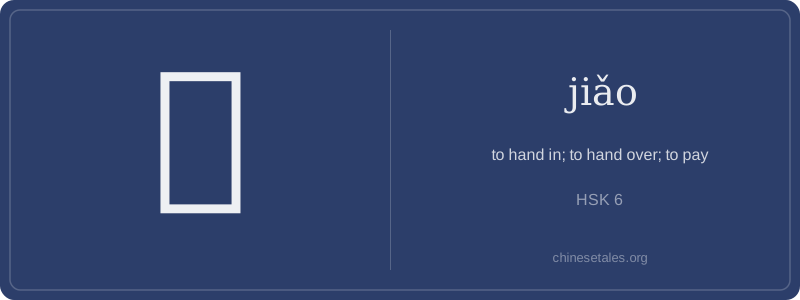
The earliest form of 缴 appears in Warring States bamboo slips as a complex ideograph: left side 糸 (silk thread, later simplified to 纟), right side 桀 (jié, an ancient pictograph of a man standing atop a platform — symbolizing control or dominance). Over centuries, 桀 evolved into 敫 (jiǎo), a phonetic component combining 白 (bái, ‘white’, suggesting clarity or record-keeping) and 攵 (pū, ‘tap/strike’, implying enforcement). By the Han dynasty, the shape stabilized into today’s 16-stroke form: 纟 + 敫 — literally ‘threaded enforcement’, visualizing the binding nature of official obligations recorded on silk or bamboo strips.
This character first appeared in classical texts like the *Book of Rites* (Lǐjì), where 缴 described the ritual surrender of weapons or tribute to a feudal lord — a physical act loaded with political symbolism. Later, in Tang legal codes, it became standard for tax remittance. Notice how the radical 纟 (silk) isn’t about fabric — it signals *record-keeping*: ancient taxes were tallied on silk scrolls. So 缴 isn’t just ‘handing over’ — it’s ‘handing over *with documentation*’. That silk thread still binds this word to bureaucracy, making every modern use — from e-filing VAT to turning in a lost ID — feel like a quiet echo of imperial ledger rooms.
At its core, 缴 (jiǎo) carries the quiet authority of obligation — not force, but formal surrender: handing over something you *must* give, whether a tax, a document, or your passport at customs. It’s never casual; you don’t ‘hand in’ your lunch to a friend — you 缴 your income tax, 缴 the rent receipt, or 缴 a report to your supervisor. The character feels bureaucratic, precise, and slightly solemn — like a clerk stamping a form with finality.
Grammatically, 缴 is a transitive verb that *requires* an object (you always 缴 *something*) and often appears in formal or institutional contexts. It rarely stands alone — you’ll see it in compound verbs like 缴纳 (jiǎo nà, ‘to pay [taxes/fees]’) or as part of set phrases like 缴销 (jiǎo xiāo, ‘to cancel/void [a license]’). Learners sometimes wrongly use it for voluntary giving (e.g., ‘I’ll 缴 you my notes’) — but that’s a no-go; use 交给 (jiāo gěi) instead. Also, note: 缴 is almost never used in past-tense narratives without aspect markers like 了 or 过 — ‘他缴了税’ sounds incomplete without context, whereas ‘他已缴清税款’ (He has fully paid his taxes) lands perfectly.
Culturally, 缴 echoes China’s long administrative tradition — from Han dynasty tax scrolls to today’s digital tax portals. Its tone (jiǎo, third tone) subtly mirrors the ‘dip-and-rise’ motion of handing something upward and forward, like placing a document on an official’s desk. A common slip? Confusing it with 交 (jiāo), which is broader and friendlier — ‘交朋友’ (make friends) vs. ‘缴罚款’ (pay a fine). One letter of formality makes all the difference.