耀
Character Story & Explanation
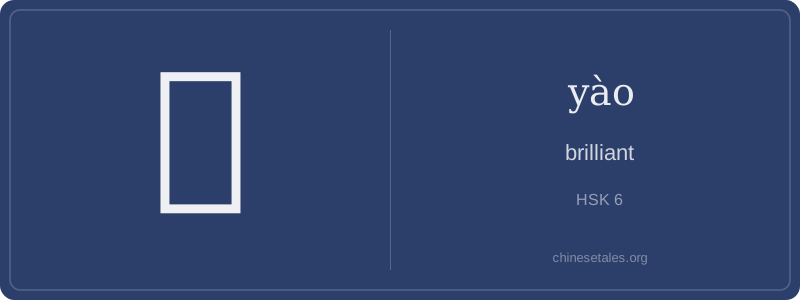
The earliest forms of 耀 appear in Warring States bamboo slips—not as a pictograph of light, but as a compound: the left side was originally 光 (guāng, 'light'), and the right was 羽 (yǔ, 'feather'), which later simplified into 羽 as the radical. The oracle bone script didn’t feature 耀 directly, but its bronze script ancestor combined 光 (a flame above a person) with 羽 (stylized feathers), evoking something luminous *in motion*—like sunlight catching iridescent wings mid-flight. Over centuries, the 光 component morphed into the top-left 耑 (yào) shape (a stylized flame + person), while 羽 remained intact at the bottom right, anchoring the character visually and semantically in lightness, elevation, and display.
This visual duality shaped its meaning: from early Han texts like the *Huainanzi*, 耀 described radiant phenomena that both illuminated and dazzled—often with moral undertones (e.g., 'the virtuous ruler’s virtue 耀于四方'). By the Tang dynasty, poets like Li Bai used 耀 to capture sudden, arresting splendor: 'starlight 耀 upon the sword' implied not just brightness but lethal readiness. Crucially, the 羽 radical wasn’t decorative—it reinforced the idea of brilliance *in flight*, *on display*, *intended to be seen*. Even today, 耀 feels airborne, performative, and impossible to ignore.
At its heart, 耀 isn’t just 'brilliant' in the physics sense—it’s brilliance with presence, impact, and even a hint of pride. Think less 'bright light' and more 'blindingly impressive achievement that demands attention.' In Chinese, 耀 almost always implies *radiating outward*: it’s not static brightness but an active, often socially charged emission—of talent, status, or glory. You don’t say 耀 to describe a lamp (that’s 亮 or 明); you use it when someone’s success shines so brightly it reflects on their family, school, or hometown.
Grammatically, 耀 is mostly verbal: 耀眼 (yào yǎn, 'dazzling to the eye'), 耀武扬威 (yào wǔ yáng wēi, 'swaggering with military might'), or the elegant verb form 耀祖 (yào zǔ, 'to bring honor to one’s ancestors'). It rarely stands alone as an adjective—unlike English 'brilliant,' you won’t hear *'tā hěn yào'*; instead, it’s embedded in compounds or used reflexively, like 闪耀 (shǎn yào, 'to shine forth'). Learners often overuse it where 亮 or 明 suffices—or mistakenly treat it as a neutral descriptor, missing its inherent connotation of social resonance and sometimes even boastfulness.
Culturally, 耀 embodies the Confucian ideal of *glory-through-merit*: your brilliance must be earned, visible, and beneficial to your lineage or community. That’s why 耀祖 is such a powerful phrase—it’s not vanity, but filial duty fulfilled. A common slip? Using 耀 where 晃 (huǎng, 'to flicker') or 熠 (yì, 'glistening') fits better—especially in poetic or delicate contexts. Remember: 耀 has weight, heat, and social gravity.