耕
Character Story & Explanation
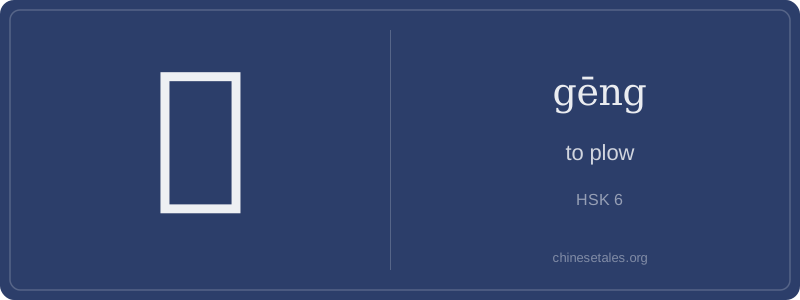
The earliest form of 耕 appears in bronze inscriptions around 1000 BCE — not as a single character, but as two joined elements: the left side was 耒 (lěi), a stylized drawing of a primitive wooden plow with a curved handle and pointed share, and the right side was 井 (jǐng), originally picturing intersecting field boundaries — not a well! This wasn’t 'well + plow'; it was 'plow + grid-patterned farmland', visually declaring 'to work the bounded, cultivated plot'. Over centuries, 井 simplified into 更 (gēng), partly due to phonetic borrowing (both 井 and 更 were pronounced similarly in Old Chinese), and the plow radical 耒 remained proudly front-and-center — a rare case where the tool defines the action.
This visual logic held firm: 耒 anchors meaning (agricultural labor), while 更 hints at change, renewal, and cyclical effort — after all, plowing turns soil over, preparing it for new growth. By the Han dynasty, 耕 was standard in texts like the *Book of Rites*, which prescribed seasonal plowing rituals. The character’s structure itself enacts its meaning: the left hand (耒) pushes forward, the right side (更) signals transformation — together, they embody purposeful, generative change. Even today, when writers use 耕 metaphorically (e.g., 耕云播雨 — 'plow clouds and sow rain', meaning to summon blessings), they’re invoking this ancient synergy of human will and natural rhythm.
Think of 耕 (gēng) as the Chinese equivalent of 'breaking ground' — not just physically turning soil, but launching something foundational: a project, a relationship, even a philosophical inquiry. In English, 'to plow' evokes hard labor and preparation; in Chinese, 耕 carries that same weight of earnest, sustained effort — but it’s also metaphorical gold. You don’t just 耕 land; you 耕心 (gēng xīn, 'plow the heart') — a classical idiom meaning to cultivate inner virtue, like Confucius urging self-reflection as tilling fertile moral soil.
Grammatically, 耕 is almost always transitive and formal — you’ll rarely hear it in casual speech ('I plowed the field yesterday' → 我昨天耕地了 is grammatical but sounds stiff; farmers say 翻地 or 旋地). Instead, it shines in written contexts: news headlines (‘耕海’ — 'plowing the sea', i.e., developing marine resources), academic essays ('耕读传家' — 'farming and studying passed down through generations'), or poetic compounds. It’s rarely used alone as a verb without an object or compound — unlike English, where 'plow' can be intransitive ('The tractor plowed along').
Culturally, 耕 isn’t just agrarian nostalgia — it’s encoded in China’s civilizational self-image. The emperor performed the 'plowing ceremony' (藉田礼) each spring to symbolize his duty to nurture the people. Learners often overuse it trying to sound literary, or misplace tones (gēng ≠ gèng or gěng); remember: only gēng, with first tone, and nearly always paired — never '我耕' alone. Its power lies in partnership: with land, with time, with tradition.