耸
Character Story & Explanation
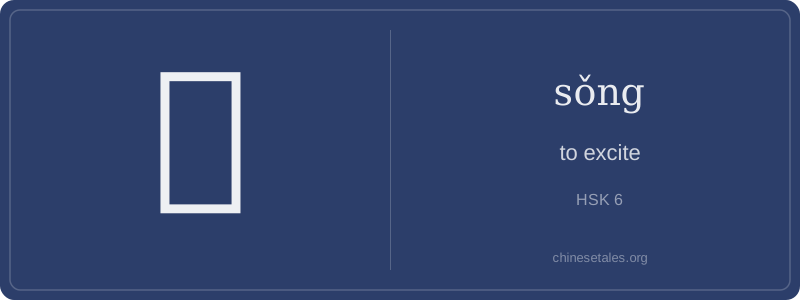
The earliest form of 耸 appears in bronze inscriptions as two stacked 'hands' (, later simplified to 从) above an ear (耳) — but wait: those 'hands' weren’t hands at all! They were stylized depictions of *feathers* or *plumes*, symbolizing something light yet dramatically upright — like startled feathers bristling. Over centuries, the upper element condensed into 从 (cóng, 'to follow'), phonetically hinting at sǒng while visually retaining that sense of upward motion; the lower 耳 remained, anchoring the character not in sound, but in the body’s physical reaction — ears pricking, hair lifting, the whole body recoiling upward.
This visual logic deepened in classical usage: in the Shuō Wén Jiě Zì (121 CE), 耸 is defined as 'shàn ér qǐ yě' (to rise suddenly, as if startled), linking it to involuntary bodily elevation. By the Tang dynasty, poets used 耸立 to describe mountains piercing clouds — no longer just fear, but sublime vertical power. The ear didn’t mean 'listening'; it meant the *body’s alert response system*. That ancient feather-ear combo still pulses in modern usage: every time you read 耸人听闻, you’re seeing 2,000-year-old plumage flaring in alarm.
At first glance, 耸 might seem like it’s about ears — after all, it wears the 耳 (ear) radical proudly. But don’t be fooled: this character isn’t about hearing at all. Its core feeling is *vertical intensity* — things rising sharply, jolting upward, or provoking a visceral physical reaction (goosebumps, hair standing on end, shoulders jerking up in shock). Think less 'listen' and more 'jolt!' — like your spine tightening when a thriller plot twist hits.
Grammatically, 耸 is almost always used in compound verbs: 耸动 (sǒng dòng, to stir up), 耸人听闻 (sǒng rén tīng wén, literally 'make people’s ears stand up' → sensational), or as part of descriptive phrases like 耸立 (sǒng lì, to tower). You’ll rarely see it solo — it’s a team player, adding urgency and vertical energy to verbs and adjectives. Learners often misread it as passive ('being excited') when it’s inherently active and causative: it *causes* excitement, alarm, or awe — not receives it.
Culturally, 耸 carries a subtle warning tone: 耸人听闻 implies exaggeration or manipulation, while 耸立 evokes awe mixed with intimidation (think skyscrapers or cliffs). A common mistake? Using it like English ‘excite’ intransitively (e.g., 'The news excited me' → *not* '新闻耸了我'). Instead, it’s 'The news *stirred up* public concern' (新闻耸动了公众情绪). It’s not emotion — it’s the spark that ignites the flame.