肴
Character Story & Explanation
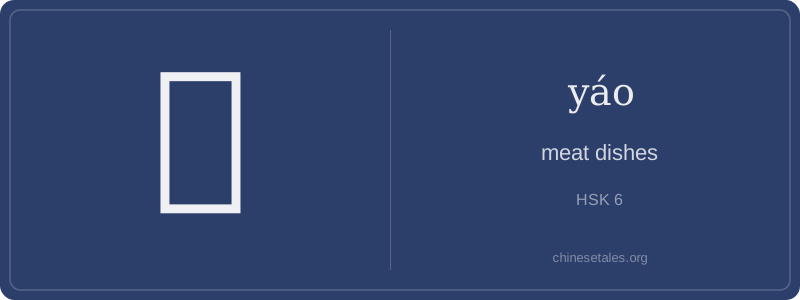
The earliest form of 肴 appears in bronze inscriptions as a pictograph combining ⺼ (flesh/meat radical, bottom) with 有 (yǒu, ‘to have’) above — not as a phonetic, but as a semantic indicator meaning ‘possessing meat’. Over time, the top evolved from 有 into the simplified shape we see today: two horizontal strokes, a vertical, and a dot — a stylized abstraction of ‘having substance’. The radical ⺼ (a variant of 月, meaning ‘flesh’) anchors it firmly in the realm of animal protein, distinguishing it from plant-based food characters like 菜 or 果.
By the Warring States period, 肴 appeared in texts like the *Zuo Zhuan* describing ritual banquets where ‘six kinds of 肴’ were arranged according to rank and season. Its meaning never drifted toward general food — instead, it deepened its association with *prepared, honored meat*: roasted venison, cured pork, braised goose. The visual structure reinforces this: the top suggests ‘presence’ or ‘possession’, the bottom declares ‘flesh’ — together, they whisper: ‘Here is meat, deliberately brought forth.’
Think of 肴 (yáo) as Chinese cuisine’s equivalent of the Michelin Guide’s ‘signature dish’ — not just any food, but artfully prepared meat-based delicacies served at banquets, in classical poetry, or on ancestral altars. It carries weight and ceremony: you wouldn’t use it for a quick stir-fry of chicken at home — that’s 菜 (cài); 肴 implies intention, craft, and often prestige. It’s almost always a noun, rarely a verb, and nearly always appears in compound words (like 山珍海味) or formal descriptions of feasts.
Grammatically, 肴 is uncountable and rarely stands alone — you’ll almost never say *‘three 肴’*; instead, it appears in phrases like 佳肴 (jiā yáo, 'excellent dishes') or 野肴 (yě yáo, 'wild-game delicacies'). Learners often mistakenly substitute it for 食 (shí) or 菜 (cài), but those are generic; 肴 is inherently *refined*, *meat-centric*, and *ritual-adjacent*. It’s also tone-sensitive: mispronouncing yáo as yǎo (third tone) evokes the verb 拗 (to twist), instantly breaking the culinary mood.
Culturally, 肴 echoes ancient Zhou dynasty banquet culture — where meat dishes signaled status, virtue, and cosmological harmony. Today, it survives most vividly in literary Chinese, restaurant menus aiming for elegance, and wedding banquets. A common mistake? Using it in casual speech: saying ‘我家的肴很好吃’ sounds like your takeout is being reviewed by Confucius. Reserve it for moments when the chopsticks pause — and the guests lean in.