肿
Character Story & Explanation
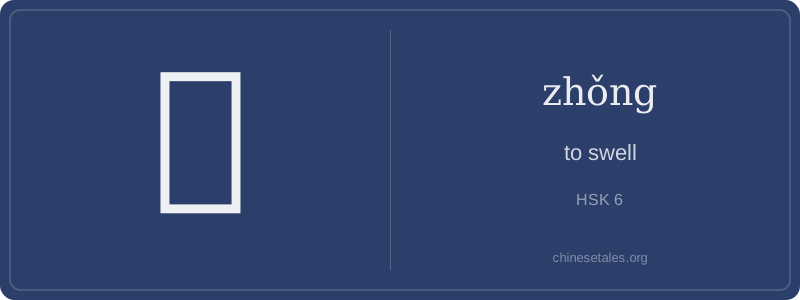
The earliest form of 肿 appears in Han dynasty clerical script, not oracle bones — it’s a relatively late-comer to the character family. Its left side ⺼ (ròu, 'flesh') is unmistakable: three dots and a bent stroke representing muscle tissue. The right side 是 (shì, 'is') was originally a simplified depiction of a foot stepping forward — but here, it’s purely phonetic, lending the 'zhǒng' sound. Over centuries, the flesh radical shrank and standardized into the modern ⺼, while 是 lost its leggy realism and hardened into its crisp, angular form — eight strokes total, each one a quiet nod to biology and sound.
This character crystallized during the Eastern Han, when medical texts like the Shanghan Lun began systematically categorizing bodily distortions. 肿 wasn’t just visual swelling — it signaled imbalance: excess dampness, stagnant qi, or toxic heat. Classical poets later borrowed it sparingly but powerfully: Du Fu wrote of 'swollen rivers' (江肿) during floods — not literal edema, but a visceral personification of nature’s swollen wrath. Even today, the character’s shape whispers its truth: flesh + 'is' = the body declaring, unambiguously, 'this is swelling.'
At its core, 肿 (zhǒng) isn’t just ‘to swell’ — it’s the body’s urgent, often uncomfortable, physical protest: inflamed joints, a bee-stung lip, or post-surgical tissue rebellion. Unlike generic verbs like 变大 (biàn dà, 'become big'), 肿 carries medical weight and visceral immediacy — you’d say 手指肿了 (shǒu zhǐ zhǒng le, 'my finger swelled up') after a burn, not 手指变大了. It’s almost always intransitive and appears with aspect particles like 了 or 过, signaling a change of state.
Grammatically, it’s deceptively simple but tricky for learners: it rarely takes an object directly (no *肿它), and never means 'to inflate' abstractly (e.g., you can’t say *经济肿了 for 'the economy inflated'). Instead, it’s tightly bound to biological tissue — skin, limbs, organs. Mistake alert: Don’t confuse it with 胀 (zhàng), which covers internal bloating (stomach, emotions) or mechanical inflation (balloons). Also, avoid using 肿 as a noun without context — while 肿 (zhǒng) *can* mean 'swelling' as a noun (e.g., 眼睑肿), it’s far more common as a verb or in compound nouns like 水肿.
Culturally, 肿 appears frequently in traditional Chinese medicine texts describing pathological accumulations — think 'wind-damp swelling' or 'liver-fire-induced facial swelling'. Modern usage leans clinical but retains poetic grit: writers use it metaphorically for social 'inflammation' — e.g., 舆论肿胀 (yúlùn zhǒngzhàng, 'public opinion swelling') — though this remains rare and stylistically bold. Learners often overgeneralize it; remember: if it’s not flesh, fluid, or inflammation, it’s probably not 肿.