膛
Character Story & Explanation
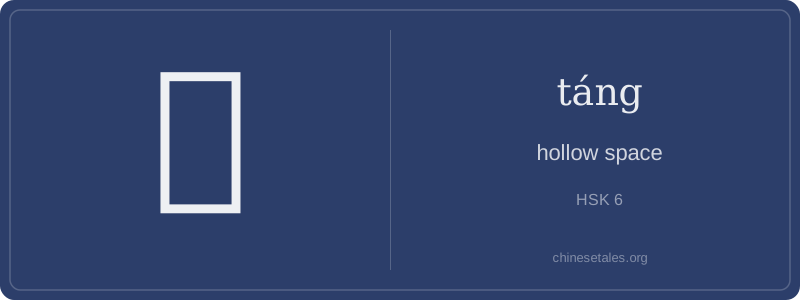
The earliest form of 膛 appears in Han dynasty seal script, built from ⺼ (a variant of 月, meaning 'flesh/body') on the left and 堂 (táng, 'hall') on the right. The left side wasn’t abstract — it originally depicted a stylized ribcage or torso contour, later standardized as ⺼. The right side, 堂, was not borrowed randomly: its ancient form showed a roof over a square enclosure — a literal 'hollowed-out space'. So visually, 膛 fused 'body' + 'enclosed interior', stroke by stroke: first the flesh radical (⺼), then the roof (宀), then the 'earth' (土) base — all 15 strokes locking in the idea of a protected, internal cavity.
By the Tang dynasty, 膛 had shifted from poetic anatomical usage (e.g., Du Fu’s line ‘胸膛如鼓’ — 'chest like a drum') to technical precision in metallurgy and medicine. The Kangxi Dictionary (1716) defines it as 'the inner cavity of a vessel or body', cementing its dual identity: biological and mechanical. Even today, its shape whispers that duality — the softness of flesh radical cradling the rigid architecture of 堂.
Imagine a blacksmith in an old Beijing courtyard, hammering red-hot iron. He pauses, wipes sweat from his brow, and gestures toward the hollow interior of a newly forged cannon barrel — 'tāng!' — pointing not to the metal wall, but to the empty, resonant space within. That’s 膛: not just 'hollow', but the *functional cavity* — the breathing chamber of lungs, the firing chamber of a gun, the echoing core of a bell. It’s anatomical, mechanical, and acoustic all at once — always implying capacity, resonance, or containment.
Grammatically, 膛 is almost never used alone. It appears in compound nouns (like 胸膛 or 枪膛) and rarely as a verb. Learners often mistakenly treat it like a general word for 'space' — but you’d never say 'the room’s táng'; instead, you say 房间 (fángjiān). Also, it’s strictly neutral in tone and almost always preceded by another noun (e.g., 心膛, not *膛心). Its measure words? None — it’s uncountable, like 'water' or 'air' in English.
Culturally, 膛 carries visceral weight. In classical texts, it evokes qi circulation (e.g., 《黄帝内经》 references 心膛 as the seat of spirit), while in modern military jargon, 枪膛 is inseparable from precision and danger. A common error: confusing it with 堂 (táng, 'hall') — same sound, totally different world. Pronounce it firmly, like 'tahng' with a short, open vowel — not 'tong' or 'tang'.