铺
Character Story & Explanation
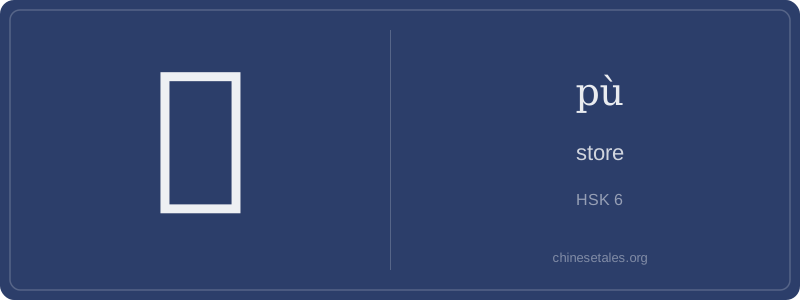
The earliest form of 铺 appears in bronze inscriptions of the Warring States period, where it combined 金 (jīn, ‘metal’) — later simplified to 钅 — with 捕 (bǔ, ‘to catch’). But this wasn’t about hunting! The ‘metal’ radical signaled tools or implements used in trade, while 捕 evolved graphically from a hand grasping a net — symbolizing ‘gathering’ or ‘displaying’ goods. Over centuries, the right side condensed into 尃 (fū), then further simplified to 甫, and finally to the modern 甫 shape you see today — all while retaining that core idea of ‘setting out goods for sale’.
By the Tang and Song dynasties, 铺 had crystallized as a term for licensed commercial stalls along city streets — often regulated by government ‘market bureaus’ (市铺). In Dream of the Red Chamber, characters visit silk shops (绸缎铺) and inkstone shops (砚台铺), revealing how these establishments were woven into daily ritual and status display. Visually, the metal radical (钅) reminds us that early shops dealt in metal tools, coins, or hardware — anchoring commerce in tangible, valuable matter. Even today, the character’s sharp, grounded strokes echo the solidity of a shop’s threshold — a place where value is measured, exchanged, and remembered.
At its heart, 铺 (pù) isn’t just ‘store’ — it’s a snapshot of traditional Chinese urban life: a family-run shop with a wooden counter, goods neatly displayed, and the quiet dignity of craft passed down generations. Unlike generic terms like 商店 (shāngdiàn), 铺 carries warmth, specificity, and a whiff of alleyway authenticity — think of a century-old herbalist’s shop (药铺) or a steamed-bun stall (包子铺). It evokes intimacy, not scale.
Grammatically, 铺 is almost always a noun and appears in compound nouns, rarely standing alone. You’ll hear it after descriptive nouns (茶铺, 修车铺) or before classifiers (一家铺), but never as a verb — that’s crucial! Learners sometimes mistakenly use it like ‘to open a store’ (❌ 我铺了一个店), when the correct verb is 开 (kāi): ✅ 我开了一家铺. Also, note that 铺 must be preceded by a classifier (e.g., 一家铺, 这个铺) — unlike English ‘store’, it’s not bare-noun friendly.
Culturally, 铺 reflects China’s long history of neighborhood-based commerce: small, trusted, locally rooted. In classical texts like The Scholars, 铺 often signals social mobility — a merchant rising from humble shopkeeper to respected community figure. A common slip? Confusing 铺 (pù) with the verb form 铺 (pū, ‘to spread out’), which shares the same character but changes meaning entirely with tone — like mistaking ‘wind’ (noun) for ‘wind’ (verb). Tone isn’t optional here — it’s semantic destiny.