希
Character Story & Explanation
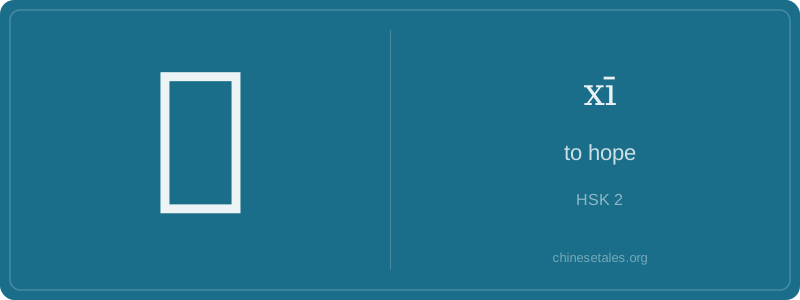
Carve this into your mind: the earliest form of 希 (in bronze inscriptions, c. 1000 BCE) wasn’t about hope at all — it was a stylized picture of a *sieve* or *meshed cloth*, with parallel horizontal lines crossing vertical ones. That’s where the radical 巾 (jīn — cloth) comes from: the top part originally depicted woven threads. Over centuries, the lower part simplified from a complex mesh symbol into the modern 巾 + 爻 (yáo — 'divination lines', later stylized as the X-shaped strokes beneath). The character didn’t start meaning 'hope' until the Warring States period — because sieves were used to *separate the rare from the common*, leading to the homophone 稀 (xī — 'rare'), and then, by poetic extension, to 'that which is rare and therefore deeply wished for'.
This semantic leap — from physical filter → rarity → yearning — is pure classical Chinese wordplay. By the time of the Analects, 希 appears in phrases like 希言自然 (xī yán zì rán — 'Rare words accord with nature'), where its root sense of 'scarcity' still echoes. But by the Han dynasty, 希 had fully merged with 希望 in texts like the Book of Rites, cementing its emotional role. Notice how the visual X-shape beneath the cloth (巾) looks like crossed arms reaching forward — a subtle, ancient echo of hoping hands.
At its heart, 希 (xī) is the quiet, forward-leaning pulse of hope — not the loud cheer of victory, but the soft breath before a wish takes shape. It’s a verb meaning 'to hope' or 'to wish for', and it almost always appears in compound verbs like 希望 (xī wàng) or as part of polite, tentative expressions: 'I hope you’re well', 'We hope this helps'. Unlike English 'hope', which can stand alone ('I hope!'), 希 rarely appears solo in modern speech — you’ll almost never hear just 'xī!' as an exclamation. Instead, it’s the first half of 希望, the engine inside polite requests and gentle aspirations.
Grammatically, 希 is strictly verb-only and requires an object or complement. You say 希望你来 (xī wàng nǐ lái — 'I hope you come'), but never *希你来. Learners often overextend it by trying to use it bare, or confuse it with 想 (xiǎng — 'to want/think') — but while 想 expresses desire or mental activity, 希 carries a layer of respectful distance and openness to possibility. It implies humility: 'I hope (but I don’t presume)'.
Culturally, 希 reflects a Confucian-tinged restraint — hope isn’t demanding; it’s courteous, even vulnerable. That’s why it shines in formal letters ('谨此希望…'), New Year greetings ('祝您万事如意,心想事成!'), and classroom phrases like 希望大家认真听讲. A common mistake? Using 希 instead of 愿 (yuàn) for solemn vows ('I wish to dedicate my life...') — 愿 conveys resolve; 希 conveys gentle expectation. Also, watch the tone: xī (first tone), never xí or xǐ — mispronouncing it risks sounding like 'rare' (稀) or 'wash' (洗).