艘
Character Story & Explanation
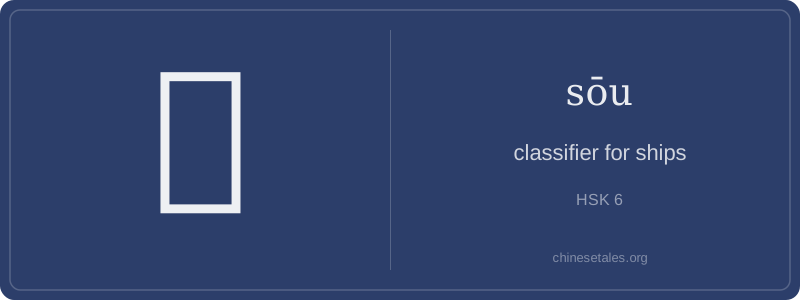
The earliest form of 艘 doesn’t appear in oracle bones — it’s a later invention, born during the Warring States period when shipbuilding flourished along the Yangtze and Huai rivers. Its left side 舟 (zhōu) — the 'boat' radical — was already an elegant pictograph of a simple dugout canoe with raised bow and stern. The right side 搜 (sōu), added later as a phonetic component, originally meant 'to search' or 'to comb through,' but here it served purely to signal pronunciation. Over centuries, the two parts fused: the boat radical stayed intact, while 搜 simplified — its 手 (hand) component became 才, and the 米 (rice) evolved into the top dot and crossbar under the 丿, giving us today’s sleek 15-stroke form.
This character didn’t exist in early classics like the Book of Songs — ships were just called 舟 or 船. But by the Tang dynasty, as maritime trade boomed and naval records grew precise, scribes needed a dedicated classifier to distinguish individual vessels in inventories and decrees. The choice of 搜 as the phonetic wasn’t random: its connotation of 'thorough enumeration' subtly reinforced the idea of counting each ship methodically — one by one, like scanning a harbor. In Su Shi’s travel essays, he notes '见巨舰三艘' ('saw three massive warships'), using 艘 to evoke both scale and official gravity — a usage that still resonates in modern naval reports.
Think of 艘 (sōu) not as a dry 'measure word' but as a quiet, respectful nod to the ship itself — like saying 'vessel' instead of 'boat' in English. It’s exclusively for ships and boats, never for cars, planes, or even rafts; it carries a subtle sense of scale, tradition, and maritime dignity. You’ll hear it in formal reports, naval contexts, and literature — never in casual chat about your friend’s inflatable kayak (that’s 条 or 只). Its core feel is 'structured, seaworthy, singular.'
Grammatically, 艘 always appears after a number or demonstrative: 一艘 (yī sōu), 这艘 (zhè sōu), 那三艘 (nà sān sōu). Crucially, it *cannot* stand alone — you’d never say 'I saw a sōu'; you must say 'I saw *one* sōu.' Learners often mistakenly use it with aircraft (wrong!) or omit the numeral (e.g., '我看见艘船' — missing '一' or '这'), which sounds jarringly incomplete to native ears.
Culturally, 艘 reflects China’s deep river-and-coastal heritage: from Song dynasty grain barges on the Grand Canal to modern PLA Navy frigates, this classifier honors the vessel’s role as lifeline, weapon, and symbol of sovereignty. A common mistake? Using it for submarines — they’re classified by 艘 *only* when surfaced or referred to as surface-capable vessels; otherwise, 艘 feels too 'above water.' Also, note that in poetry or historical texts, 艘 may appear in compounds like 楼船 (lóu chuán, 'tower ship') — reinforcing its association with grand, manned, decked vessels, not dinghies or ferries.