芽
Character Story & Explanation
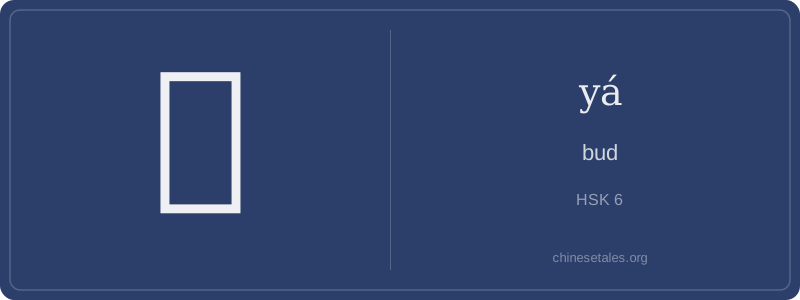
Trace 芽 back to its earliest form in bronze inscriptions (c. 1000 BCE), and you’ll find a stylized pictograph: two small, upward-curving lines (representing tender leaves) sprouting from a simple horizontal line (the ground or soil), all under a clear 'plant' canopy. Over centuries, this simplified: the canopy became the standard 艹 radical (three strokes, representing grass/plants), while the sprout itself evolved into 牙 — originally depicting two opposing, jagged shapes (like interlocking teeth or split seed coats), capturing the forceful, piercing energy of a seed cracking open. By the Han dynasty, the modern seven-stroke form was fixed: 艹 (3 strokes) + 牙 (4 strokes).
This visual evolution mirrors its semantic journey. Early texts like the *Shuōwén Jiězì* (121 CE) defined 芽 as 'the beginning of growth in plants', emphasizing its temporal quality — the *first moment* of visible life. Classical poets loved its duality: Li Bai used it to contrast fragility and tenacity ('a single芽in the cliffside wind'), while Song dynasty scholars extended it to 'the initial sign of virtue'. The 牙 component wasn’t arbitrary: ancient Chinese observed how sprouts push through earth with tooth-like pressure — making this character a brilliant fusion of sight, sound (yá), and biomechanical truth.
At its heart, 芽 (yá) is a tiny explosion of life — not just a botanical 'bud', but a potent symbol of emergence, potential, and the very first stirrings of something new. Visually, it’s a perfect marriage: the radical 艹 (cǎo zì tóu, 'grass radical') anchors it firmly in the plant world, while the right side 牙 (yá, 'tooth') isn’t about dentistry — it’s a phonetic clue *and* a visual metaphor: sharp, pointed, pushing upward like a sprout breaking soil. This dual role makes 芽 unusually vivid for a concrete noun.
Grammatically, 芽 is versatile but precise. It’s almost always a noun (rarely a verb), and it appears in compound nouns far more often than alone — think 萌芽 (méng yá, 'germ of an idea') or 新芽 (xīn yá, 'new bud'). Crucially, it implies *incipience*: you wouldn’t say 'the flower has a bud' with 芽 unless that bud is visibly emerging *now*. Learners often overuse it for generic 'plant part' or confuse it with leaves (叶 yè) or stems (茎 jīng). Also, note: while English says 'a bud', Chinese usually omits the measure word with 芽 in compounds — we say 发芽 (fā yá, 'to sprout'), not *fā yī gè yá*.
Culturally, 芽 carries quiet optimism. In classical poetry, it signals spring’s return and resilience (e.g., Bai Juyi’s 'wildfire cannot burn it all away; spring breeze blows, and grass grows anew' — though he uses 草, the sentiment lives in 芽). Modern usage extends metaphorically to ideas, movements, or talents ('the芽of reform', 'a musical芽'). A common slip? Writing 牙 instead of 芽 — which literally gives you 'tooth' instead of 'bud', turning your delicate spring image into a dental appointment!