萎
Character Story & Explanation
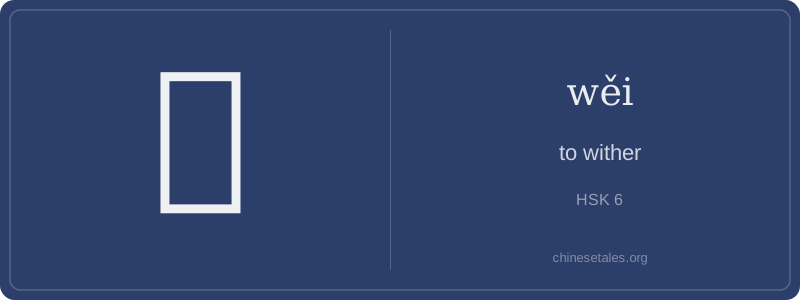
The earliest form of 萎 appears in Warring States bamboo slips as a composite: top was 艸 (later simplified to 艹), representing plants; bottom was 委 (wěi), originally a pictograph of a woman bending low under a burden — her spine curved, arms slack. This wasn’t just ‘bending’; it conveyed yielding, collapse, loss of upright strength. Over centuries, the ‘woman’ (女) in 委 stylized into 丿一女 → → 矣, while the grass radical stabilized above — preserving the dual idea: vegetation losing its vertical life-force.
This visual logic endured: in the *Shuōwén Jiězì* (121 CE), Xu Shen defined 萎 as ‘grass bending and falling — unable to stand upright,’ linking botanical and moral frailty. By the Tang dynasty, poets like Bai Juyi used 萎 metaphorically: ‘志气日以萎’ (‘my willpower withers day by day’), cementing its role in describing internal, invisible decline. Even today, the character’s 11 strokes echo that original curve — the final stroke (㇏) sweeps down like a drooping petal, a silent visual sigh.
At its core, 萎 (wěi) isn’t just ‘to wither’ — it’s the slow, quiet surrender of vitality: a plant collapsing under drought, enthusiasm fading into apathy, or ambition shriveling from neglect. It carries a subtle sense of irreversible decline, often with emotional or systemic weight — not sudden death, but gradual loss of vigor. Unlike generic verbs like 枯 (kū, 'to dry up'), 萎 implies visible physical drooping or sagging (think limp stems, slumped shoulders, or flagging morale).
Grammatically, 萎 is primarily an intransitive verb (e.g., 花萎了 — 'the flower wilted'), but it also appears in compound verbs like 萎缩 (wěisuō, 'to shrink/atrophy') and as an adjective in literary contexts (e.g., 萎靡 — wěimǐ, 'listless'). Crucially, it rarely takes an object directly — you wouldn’t say *‘wither the flower’* with 萎; instead, use 使…萎 or opt for causative compounds. Learners often mistakenly use it transitively or confuse it with passive constructions.
Culturally, 萎 resonates beyond botany: in classical texts like the *Zuo Zhuan*, it describes moral decay ('virtue withers'); in modern usage, it’s frequent in medical (muscle atrophy), economic (market stagnation), and psychological (motivational collapse) discourse. A common error? Overusing it for temporary tiredness — 萎 suggests deeper, structural depletion, not mere fatigue. Think ‘chronic exhaustion,’ not ‘I need coffee.’