蔑
Character Story & Explanation
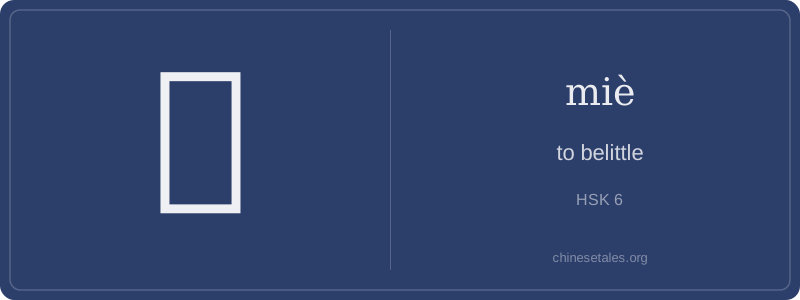
The earliest form of 蔑 appears in bronze inscriptions as a complex glyph combining 艸 (grass/plant) and a stylized weapon or cutting tool — possibly a halberd (戈) with a downward stroke symbolizing forceful severance. Over centuries, the grass radical (艹) stabilized at the top, while the lower component evolved from 戊 (wù, an ancient axe) plus a vertical stroke (丨) representing decisive, downward contempt — not just seeing low, but *cutting down*. By the seal script era, the shape had condensed into today’s 14-stroke structure: three grass strokes above, then 戊 (itself composed of ㇆, 一, 丿, ㇏), capped by the emphatic vertical line.
This visual logic mirrors its semantic journey: from literal ‘cutting down plants’ (early agricultural metaphor) to figurative ‘cutting down a person’s dignity’. In the *Analects*, Confucius warns against those who ‘蔑德’ (miè dé — ‘scorn virtue’), linking physical severance to moral erosion. The character’s enduring power lies in that fusion — the gentle grass radical (艹) ironically framing a gesture of violent dismissal, reminding readers that contempt often hides beneath polite surfaces.
At its heart, 蔑 (miè) isn’t just ‘to belittle’ — it’s the sharp, deliberate act of *erasing someone’s worth*, like brushing away dust from a priceless scroll. It carries moral weight and often implies arrogance or ideological contempt, not casual teasing. You’ll rarely hear it in everyday chit-chat; it’s reserved for formal criticism, historical judgment, or literary scorn — think newspaper editorials condemning corruption or scholars dismissing flawed theories.
Grammatically, 蔑 is almost always transitive and appears in compound verbs like 蔑视 (mièshì, ‘to despise’) or standalone in classical-style constructions: ‘他蔑此言’ (Tā miè cǐ yán — ‘He dismissed this statement outright’). Crucially, it doesn’t take aspect particles like 了 or 过 — you won’t say *蔑了*; instead, use 蔑视了 or rephrase with verbs like 不屑一顾. Learners often mistakenly treat it like 看不起 (kàn bu qǐ), but 蔑 is colder, more absolute, and never used in spoken imperatives like ‘Don’t belittle him!’ — that’s 看不起 or 小看.
Culturally, 蔑 echoes Confucian ethics: to 蔑 someone isn’t just rude — it violates rén (benevolence) and li (ritual propriety). In classical texts like the *Zuo Zhuan*, rulers who 蔑礼 (miè lǐ — ‘scorn ritual norms’) invite disaster. Modern usage still carries that gravity — using 蔑 casually risks sounding pompous or dangerously dismissive. A common slip? Writing 蔑 as 蔑 (correct) vs. miswriting the top as 艹 + 目 (wrong); remember: it’s 艹 + 戊 + 丨 — not an eye, but a weapon-like stroke piercing downward.