蔽
Character Story & Explanation
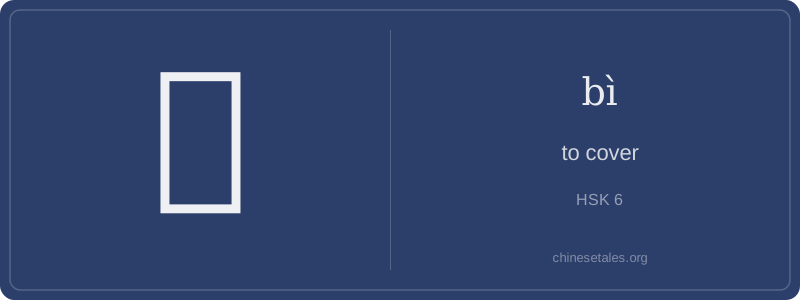
The earliest form of 蔽 (found in bronze inscriptions) combined 艸 (grass/plants, later simplified to 艹) atop 敝 — a pictograph showing tattered cloth hanging from a frame, symbolizing something worn, frayed, and thus *unable to fully conceal*. Over centuries, the top evolved into the standard grass radical, while 敝 retained its structure: the left side (攵, ‘hand with stick’) implied action, and the right (㡀) suggested fragmentation — together evoking ‘a covering that fails, or deliberately distorts’. By the seal script era, the 14 strokes locked into place: three grass strokes, then the complex 敝 component with its distinctive ‘folded cloth’ top and ‘hand-striking’ base.
This visual duality — lush vegetation (艹) *over* something broken (敝) — perfectly mirrors its semantic evolution: from literal ‘covering with foliage’ (as in ancient poetry describing reeds hiding a path) to metaphorical ‘obscuring truth through flawed perception’. The Classic of Poetry uses it in ‘fēng yǔ rú huì, jī bì rú xū’ (When wind and rain gather darkly, chickens are obscured like emptiness), linking natural obscurity to existential uncertainty. Even today, the character’s shape whispers: ‘what covers may also deceive’.
At its heart, 蔽 isn’t just ‘to cover’ — it’s *to obscure intentionally*, to veil something from view or understanding, often with a hint of concealment, bias, or even deception. Think less ‘throwing a blanket over a chair’ and more ‘clouding judgment’ or ‘obscuring truth’. It carries weight: in classical texts like the Book of Songs, it describes how mist shrouds mountains; in modern usage, it appears in phrases like yì jiàn bèi bì (opinions being obscured) — never for simple physical covering like a lid on a pot (that’s 盖 gài).
Grammatically, 蔽 is almost always transitive and formal — you’ll rarely hear it in casual speech. It frequently appears in passive constructions (bèi bì) or as part of compound verbs like zhē bì (to shield/cover up). Learners often misapply it where simpler verbs like 遮 (zhē, to block light) or 掩 (yǎn, to hide discreetly) would fit better — a subtle but critical register mismatch. Its presence signals seriousness, abstraction, or moral consequence.
Culturally, 蔽 echoes Confucian concerns about self-deception and intellectual honesty: 《論語》 warns that ‘bì yú sī’ — ‘blinded by one’s own biases’ — is a perilous state. That’s why it’s HSK 6: mastering 蔽 means grasping not just vocabulary, but a nuanced Chinese worldview where perception, truth, and intention are inseparable.