薪
Character Story & Explanation
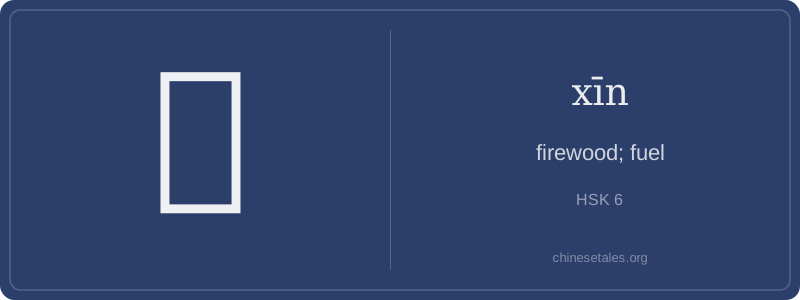
The earliest form of 薪 appears in bronze inscriptions as a pictograph showing dried branches stacked neatly beneath a roof-like canopy — a clear image of harvested, stored firewood. Over time, the top evolved into the 艹 (grass/plant) radical, signaling its botanical origin, while the bottom simplified from a complex bundle glyph into 新 (xīn, 'new'), which originally depicted an axe cutting fresh wood — a brilliant phonetic-semantic fusion: 新 provided both sound (xīn) and meaning ('freshly cut'). By the Han dynasty, the character stabilized into its current shape: 艹 above, 新 below — 16 strokes capturing the full cycle of harvest, preparation, and readiness.
This visual logic anchored its meaning for millennia. In the Classic of Poetry (Shījīng), 薪 appears in odes describing wives gathering firewood — humble yet vital labor. Later, Confucian scholars elevated it metaphorically: Mencius wrote of ‘preserving the hearth’s embers with new薪’, linking physical fuel to moral continuity. Even today, the character’s structure whispers its story: every time you see 薪, picture a hand placing freshly cut branches under shelter — not just wood, but intention made tangible.
At its core, 薪 (xīn) isn’t just ‘firewood’ — it’s *living fuel*: dry branches, cut bamboo, bundled reeds, anything deliberately gathered and prepared to sustain flame. Unlike generic 火 (huǒ, fire) or 燃 (rán, to burn), 薪 carries the quiet labor of collection, drying, and stacking — a noun steeped in effort and readiness. It’s almost always concrete and countable: you can measure 薪 in bundles (捆), stacks (堆), or loads (担), and it rarely appears abstractly.
Grammatically, 薪 is a formal, literary noun — common in classical texts and modern written Chinese but rare in casual speech (where people say 柴 or 木柴 instead). You’ll see it in set phrases like 抱薪救火 (bào xīn jiù huǒ, 'carrying firewood to put out a fire' — i.e., making a problem worse), or as a modifier: 薪水 (xīnshuǐ, 'salary') literally means 'firewood-and-water', evoking the basic sustenance one earns to keep life burning. Note: it never functions as a verb — no 'to薪' exists!
Culturally, 薪 is deeply tied to self-reliance and ancestral continuity: in ancient times, gathering firewood was daily survival work, often done by women and children; today, the compound 薪火相传 (xīn huǒ xiāng chuán, 'firewood and fire passed down') symbolizes the transmission of knowledge across generations. Learners often misread it as 'salary' alone — but that’s only in compounds; standalone 薪 means *only* fuel. And beware: it’s not interchangeable with 柴 — using 薪 in spoken Mandarin (“我买薪”) sounds stiff, archaic, or even comically over-formal.