蕴
Character Story & Explanation
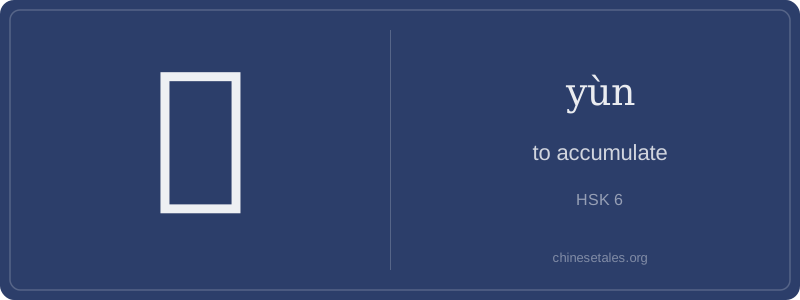
The earliest form of 蕴 appears in seal script as a combination of 艹 (grass/plant radical) on top and 温 (wēn, 'warmth') at the bottom — but crucially, the ancient version of 温 had a heart-like component (心) embedded in its structure. This wasn’t just 'warm plant' — it visualized warmth *contained within* vegetation: think of compost steaming quietly under mulch, or seeds holding life-force beneath soil. Over centuries, the heart element faded, and the bottom evolved into 焌 (a variant of 昷, itself derived from 温), while the grass radical stayed firmly atop — reinforcing that this accumulation happens organically, rooted in nature, not mechanical storage.
By the Han dynasty, 蕴 appeared in texts like the Shuōwén Jiězì as 'to gather and conceal' — especially feelings or meanings too profound for direct expression. In Tang poetry, poets praised verses with deep 意蕴 (yì yùn), where meaning bloomed slowly like ink diffusing in rice paper. The character’s visual quietness — soft grass above, contained warmth below — mirrors its semantic essence: depth isn’t loud; it’s what hums beneath silence.
Think of 蕴 (yùn) not as a dry verb meaning 'to accumulate', but as a quiet, layered process — like tea leaves steeping in hot water, slowly releasing fragrance and depth. It’s never about piling things up visibly; it’s about internal, often invisible, gathering: emotions held beneath the surface, wisdom gathered over years, or cultural meaning embedded in art. That’s why you’ll rarely see it used for stacking boxes (use 堆 duī instead), but frequently in abstract, elegant contexts: 蕴含 (yùn hán, 'to contain implicitly'), 蕴藏 (yùn cáng, 'to harbor secretly'), or 意蕴 (yì yùn, 'subtle artistic meaning').
Grammatically, 蕴 is almost always transitive and appears in compound verbs — standalone use ('I accumulate') is rare and literary. It pairs naturally with abstract nouns: time, feeling, potential, meaning. Learners often mistakenly treat it like 积累 (jī lěi, 'to accumulate through effort') — but while 积累 emphasizes active, visible accumulation (e.g., experience, capital), 蕴 implies inherent, latent richness already present, waiting to be perceived. You don’t *do* 蕴; you *discover* what’s 蕴 in something.
Culturally, this character breathes with Daoist and poetic sensibility — valuing what’s concealed, subtle, and unspoken. A classic trap? Using 蕴 to mean 'to store' physically (like storing rice). That’s 储 (chǔ) or 存 (cún). Also, watch tone: yùn (fourth tone) is distinct from yūn (first tone, 'dizzy') — mixing them turns 'richly layered meaning' into 'feeling faint'!