蛮
Character Story & Explanation
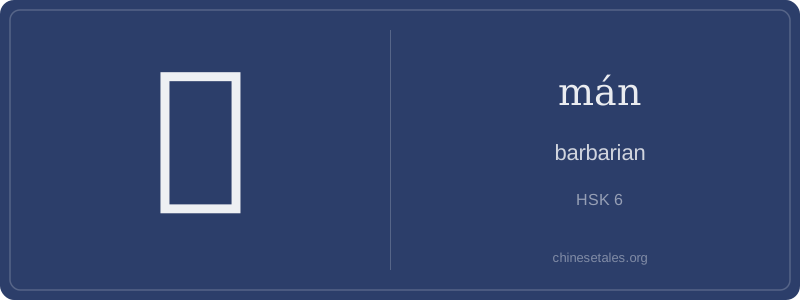
The earliest form of 蛮 appears on Warring States bamboo slips as a compound ideograph: top part ‘䜌’ (luán, meaning ‘interwoven threads’ — later simplified to 亦 + two ‘厶’ shapes), bottom part ‘虫’ (chóng, ‘insect’ or ‘creeping creature’). This wasn’t literal entomology — in ancient Chinese cosmology, ‘insect’ was a broad category for non-human, non-celestial lifeforms, often symbolizing ‘otherness’ or ‘untamed nature’. Over centuries, the upper ‘䜌’ condensed into the modern ‘亦’-like shape with two small loops (representing interwoven cultural difference), while the lower ‘虫’ stayed firmly rooted — visually anchoring the concept in the natural, unrefined world beyond ritual order.
This visual logic mirrored its semantic journey: from early Zhou bronze inscriptions describing southern tribes (南蛮) as ‘those who don’t follow our rites or speak our language’, to Han dynasty texts using 蛮夷 as a paired term for non-Han peoples, and finally to Tang-Song colloquial usage where ‘mán’ began shedding stigma — appearing in poetry as ‘mán hǎo’ (‘rather good’), perhaps because southern regions were increasingly prosperous and culturally influential. The ‘insect’ radical persisted not as insult, but as a humble, earthy reminder: civilization isn’t innate — it’s cultivated, like tending a garden among creeping vines.
Think of 蛮 (mán) as China’s ancient equivalent of the Roman ‘barbarian’ — not just a neutral ethnic label, but a loaded cultural boundary marker. In classical texts, it didn’t mean ‘savage’ in the modern moral sense, but rather ‘people outside the Zhou/Han ritual and linguistic sphere’ — like how Greeks used ‘barbaros’ (‘babblers’) for non-Greek speakers. The character carries an implicit contrast: civilization (zhōngyuán 中原) vs. periphery (nánmán 南蛮), and that tension still echoes today.
Grammatically, 蛮 is rarely used alone in modern speech — you won’t say *‘He is mán’*. Instead, it appears in fixed compounds (e.g., 蛮夷, 南蛮) or, more commonly, as an adverb meaning ‘rather’ or ‘quite’ (蛮好, 蛮有意思), a colloquial softening that ironically repurposes the ‘barbarian’ into something endearing — like calling your stubborn friend ‘a lovable rogue’ instead of ‘uncivilized’. Learners often misread this adverbial use as archaic or offensive; it’s neither — it’s warm, regional (especially Shanghai/Wu dialect-influenced), and utterly mainstream in informal Mandarin.
Culturally, the biggest trap is projecting Western colonial baggage onto 蛮. Unlike English ‘barbarian’, which implies moral inferiority, 蛮 originally described geography and ritual practice — not inherent worth. Confucius himself said, ‘The Yi and Di have rulers but no rites; the Xia has rites but no ruler — better to be a ruler without rites than a ruler with rites’ (Analects 3.5). So 蛮 isn’t about ‘savagery’ — it’s about *ritual literacy*. Modern learners who avoid 蛮 entirely miss its playful, ironic, and deeply human reinvention in everyday speech.