衰
Character Story & Explanation
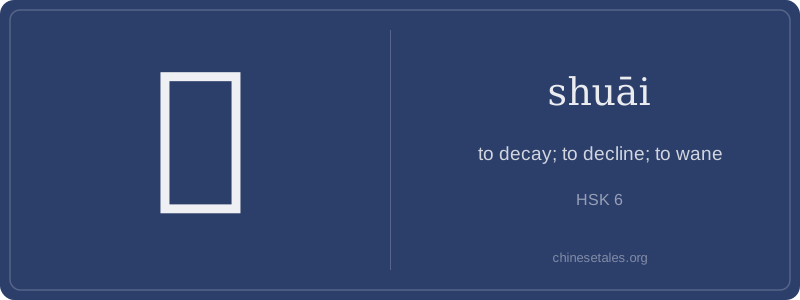
The earliest form of 衰 appears in bronze inscriptions as a stylized image of a person wearing coarse, tattered hemp clothing — think ragged robes with uneven hems and visible threads unraveling. The top part resembled hair or fibers falling; the lower part showed overlapping garment folds (hence the 衣 radical). Over centuries, the upper element simplified into the now-familiar 十 + 口 + 一 structure (a visual echo of fraying strands), while the 衣 radical anchored it firmly in the domain of material wear-and-tear — clothing being humanity’s first metaphor for decay.
This concrete origin seeded its semantic expansion: by the Warring States period, 衰 described not just worn clothes but weakened states (《左传》: '国势日衰'), and by Tang poetry, it evoked existential waning — Du Fu wrote of '鬓毛衰' (bìn máo shuāi, 'temples graying') where hair itself became a textile of time. Its shape never lost that tactile sense of unraveling: every stroke feels like a thread loosening — even today, seeing 衰 on paper triggers a faint visual shiver of things coming undone.
At its core, 衰 (shuāi) carries the visceral feeling of irreversible downward motion — like leaves curling and browning, a candle guttering low, or a dynasty’s banners fraying in the wind. It’s not just 'getting worse'; it’s organic, systemic, often melancholic decline: bodies weaken, empires crumble, enthusiasm evaporates, light fades at dusk. Unlike generic verbs like 变差 (biàn chà, 'get worse'), 衰 implies natural entropy — something aging, wearing out, or losing vitality from within.
Grammatically, 衰 is almost always used in compound verbs or adjectives — you’ll rarely see it alone. It pairs with 成 (chéng) to form 衰成 (shuāi chéng, 'decline into'), with 落 (luò) in 衰落 (shuāi luò, 'decline/fall'), or functions as a stative verb in constructions like ‘日渐衰’ (rì jiàn shuāi, 'gradually decline'). Crucially, it’s *not* used for temporary setbacks (that’s 失败 shībài), nor for moral failure (that’s 堕落 duòluò). Saying '他衰了' without context sounds oddly poetic — like calling someone a fallen star.
Culturally, 衰 taps into Daoist and Buddhist ideas of impermanence (无常 wúcháng). Learners often mispronounce it as shuāi (correct) vs. shuāi (still correct — but many mistakenly say shuāi thinking it’s shuāi like 'shuai' in 'shuaishuai'); more dangerously, they confuse it with 哀 (āi, 'grief') — writing '经济哀' instead of '经济衰', which accidentally declares 'the economy is grieving'! Also, while English says 'decline' neutrally, 衰 often carries quiet gravity — a single character that can describe both a wilting orchid and the twilight of a civilization.