袱
Character Story & Explanation
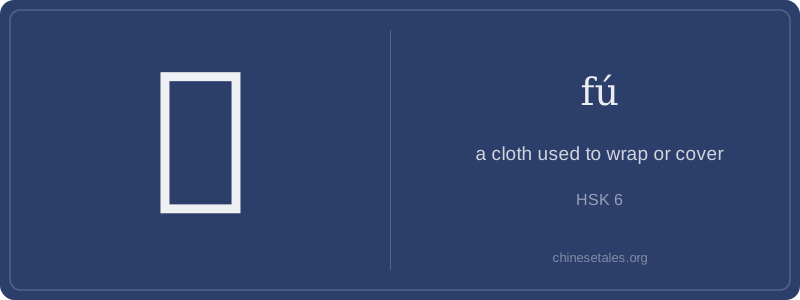
The earliest form of 袱 appears in seal script (c. 3rd century BCE), where it clearly combines 衤 (the ‘clothing’ radical, derived from 衣 yī) on the left and 福 (fú, ‘good fortune’) on the right — but not as a phonetic loan. Originally, it was written with 衣 + 复 (fù, ‘to repeat, cover again’), hinting at layered wrapping. Over time, 复 evolved graphically into 福 due to sound similarity (both pronounced fú), and scribes simplified the top of 复 to match 福’s ‘altar + hand’ structure. The 11 strokes crystallized in regular script: seven for 衤 (not the full 衣), and four for 福 — a visual marriage of clothing and auspiciousness.
This fusion wasn’t accidental: in ancient China, wrapping things — especially ritual items, gifts, or infants — was deeply tied to blessing and warding off harm. The Classic of Rites (《礼记》) notes that ‘silk 袱 must enclose jade before presentation to nobles’ — the cloth itself became part of the reverence. Even today, when elders give red envelopes, they may still place them inside a small embroidered 袱, preserving the idea that *how* you wrap matters as much as *what* you give. The character’s shape literally holds tradition within its strokes: 衤 wraps the concept, and 福 blesses the act.
At its heart, 袱 (fú) isn’t just ‘a cloth’ — it’s a quiet symbol of care, containment, and cultural pragmatism. In Chinese, this character evokes the gentle act of wrapping something precious or delicate: a baby’s blanket, a scholar’s scroll, medicine for a sick elder, or even ceremonial offerings. It carries warmth and intention — never mere utility. You won’t find it in modern casual speech like ‘bag’ or ‘box’; instead, it appears in literary, historical, or emotionally charged contexts where the *act of covering* implies protection, respect, or ritual propriety.
Grammatically, 袱 is almost always a noun and rarely stands alone — it lives inside compounds (like 包袱 or 搭袱). It never takes aspect markers (了, 过) or pluralizers (们), and you’ll almost never say ‘a 袱’ without context: it’s always *which* 袱? Whose? For what purpose? Learners often mistakenly treat it like a generic ‘cloth’ (e.g., confusing it with 布 bù), but 袱 implies function: wrapping, bundling, shielding — not fabric type or texture.
Culturally, 袱 quietly reflects how Chinese values embed meaning in gesture: the careful folding of a silk 袱 around a gift says more than words ever could. A common mistake is overgeneralizing it to mean ‘package’ or ‘bundle’ — but that’s 包 (bāo). Using 袱 where 包 fits sounds archaic or poetic, like saying ‘thou’ instead of ‘you’. And yes — the idiom ‘放下包袱’ (fàngxià bāofu, ‘put down the burden’) plays on its literal meaning, turning cloth into metaphor in a way only Chinese can.