裕
Character Story & Explanation
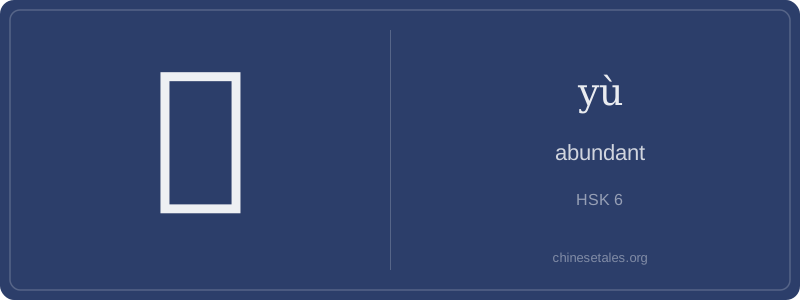
The earliest form of 裕 appears in bronze inscriptions as a combination of 衣 (clothing, later simplified to 衤) on the left and 谷 (gǔ, 'valley/grain') on the right — not as abstract symbols, but as evocative pictographs: a stylized robe draped over a fertile valley brimming with ripening millet stalks. Over centuries, the robe’s collar and sleeves condensed into the modern 衤 radical, while 谷 lost its top dot and simplified its strokes, merging into today’s clean 12-stroke structure. Every stroke tells of cloth + grain = material security made visible.
This visual logic anchored its meaning: abundance wasn’t abstract — it was the tangible, wearable, storable kind. In the *Zuo Zhuan*, 裕 describes rulers whose generosity ‘broadens the people’s hearts’ (宽裕民心), linking surplus to benevolent governance. By the Tang dynasty, poets used 裕如 to depict effortless mastery — like a calligrapher whose brush moves with unstrained fluency. The character’s enduring power lies in this fusion: the 衤 says ‘this abundance clothes and shelters us,’ while the 谷 whispers ‘it grows from the earth, patiently, collectively.’
At its heart, 裕 (yù) isn’t just ‘abundant’ — it’s *luxuriously abundant*, the kind of plenty that spills over into comfort, dignity, and even moral ease. Think not just full granaries, but well-lined robes, quiet confidence, and social standing earned through sustained prosperity. Unlike generic synonyms like 多 (duō, 'many') or 丰 (fēng, 'plentiful'), 裕 carries a warm, almost tactile sense of surplus that supports human flourishing — it’s abundance with a cushion.
Grammatically, 裕 is primarily an adjective (e.g., 富裕的家庭), but it also appears in formal nouns like 裕如 (yùrú, 'at ease; unhurried') and as part of classical compound verbs. Crucially, it rarely stands alone in speech — you’ll almost never hear someone say *‘This is yù!’* Instead, it flows in phrases: 富裕 (fùyù, 'well-off'), 宽裕 (kuānyù, 'spacious/financially comfortable'), or the literary 裕然 (yùrán, 'serenely ample'). Learners often mistakenly use it as a verb ('to make abundant') — but no: it’s a state, not an action. Also, avoid overusing it in casual talk; it sounds slightly elevated, even scholarly.
Culturally, 裕 reflects Confucian ideals where material sufficiency enables virtue — Mencius wrote that only when people have ‘enough grain and silk’ (衣食足) can rites and righteousness (礼义兴) flourish. That’s why 裕 appears in official slogans like 共同富裕 (gòngtóng fùyù, 'common prosperity'): it’s not just wealth, but equitable, sustainable abundance that dignifies everyone. A common slip? Confusing it with 欲 (yù, 'desire') — same sound, opposite ethics: one is serene fullness, the other restless craving.