讯
Character Story & Explanation
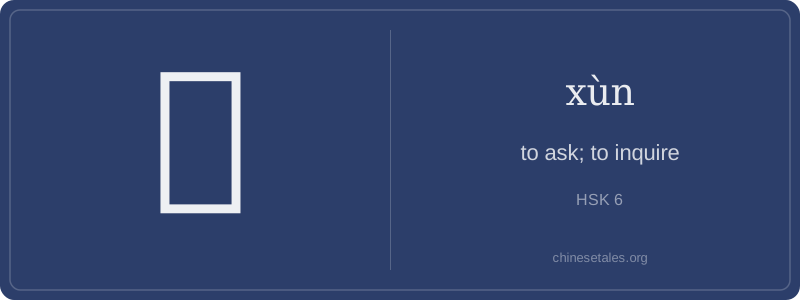
The earliest form of 讯 appears in bronze inscriptions around 1000 BCE as a combination of 言 (yán, 'speech') and 亻 (rén, 'person'), but crucially — with an extra stroke suggesting vocal projection. In oracle bone script, it wasn’t pictographic per se, but a phonetic-semantic compound: the left side 訁 (a variant of 言) signaled 'speech-related', while the right side 卂 (bì, now obsolete) provided pronunciation. Over centuries, 卂 simplified into 旬 (xún), then further streamlined to the clean, sharp 之-like shape we see today — five strokes total, all precise and pointed, like arrows of inquiry.
This visual tightening mirrors its semantic sharpening: from general 'speaking' in early Zhou texts to focused 'interrogation' by the Warring States period. Confucius used 讯 in the *Analects* (17.20) when advising rulers to '讯于众' ('inquire among the people') — not as a formality, but as ethical due diligence. The character’s minimal strokes (just five!) belie its maximal impact: every line feels like a probe — vertical stroke as authority, diagonal as direction, dots as focused attention. Even its radical 讠 — the 'speech' radical — sits left-justified, demanding immediate attention, like a raised hand in a courtroom.
At its heart, 讯 (xùn) is about directed speech — not just talking, but *asking with purpose*. Think of it as the linguistic equivalent of leaning in, making eye contact, and saying 'Excuse me — could you clarify that?' It’s formal, intentional, and often implies a power dynamic or institutional context: police讯问 suspects, journalists讯访 sources, or officials讯查 facts. Unlike casual 问 (wèn), which covers any question ('What’s for dinner?'), 讯 carries gravity — it’s interrogation, inquiry, or official investigation.
Grammatically, 讯 is almost always transitive and appears in compound verbs like 讯问 (xùn wèn, 'to interrogate') or as part of noun phrases like 消息 (xiāo xī, 'news' — literally 'disappearing + message', hinting at how information travels). You’ll rarely see it standalone as a verb in modern speech — it’s too stark. Instead, it thrives in written registers: legal documents, news headlines, academic reports. A common learner mistake? Using 讯 where 问 fits better — saying *我讯你一个问题* sounds like you’re summoning someone to a tribunal, not asking politely!
Culturally, 讯 evokes authority and accountability. In classical texts like the *Zuo Zhuan*, 讯 appears in contexts of judicial review — 'examining testimony before judgment.' Today, it still bears that weight: a journalist who '讯' a politician isn’t just chatting — they’re holding them to account. Learners should note its tone: xùn (fourth tone) rhymes with 'soon', reinforcing urgency — this isn’t small talk; it’s time-sensitive truth-seeking.