讼
Character Story & Explanation
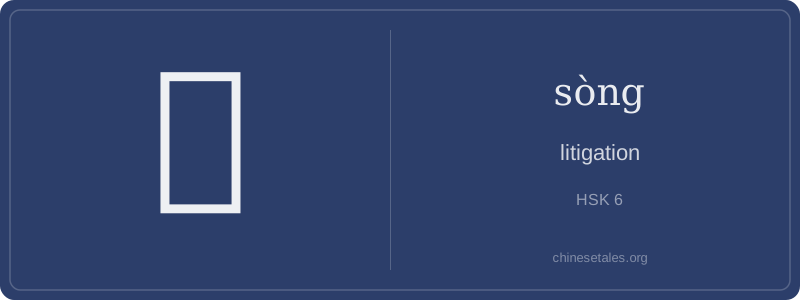
The earliest form of 讼 appears in bronze inscriptions of the Western Zhou (c. 1046–771 BCE), where it resembled two mouths (口口) facing each other across a line — symbolizing opposing verbal claims. By the Warring States period, one ‘mouth’ evolved into the radical 讠 (speech radical), while the right side solidified into 公 (gōng, ‘public’ or ‘impartial’), reflecting the core idea: *disputes settled before a public, impartial authority*. The modern six-stroke form — 讠+公 — crystallized in the Han dynasty, shedding pictographic clutter but preserving its judicial soul: speech directed at justice.
This visual logic shaped its meaning: 讼 wasn’t just ‘arguing,’ but *structured, authoritative verbal contention*. In the Classic of Rites (Liji), 讼 appears alongside ‘狱’ (yù, ‘criminal case’) to distinguish civil disputes from criminal ones — a distinction still embedded in modern Chinese law. Even today, the character’s shape whispers its origin: the speech radical (讠) insists this is about *words*, not fists; 公 insists those words must appeal to fairness, not power. No wonder classical poets used 讼 to evoke moral tension — like Du Fu lamenting how ‘讼’ could fracture village trust.
Imagine a bustling Song Dynasty yamen (county courthouse) where two merchants glare at each other across a lacquered table, each jabbing a finger while shouting grievances — not in rage, but in precise, formulaic language. This isn’t chaos: it’s 讼 (sòng), the quiet, high-stakes art of *formal litigation*. Unlike the English ‘lawsuit’ — which sounds procedural — 讼 carries an ancient weight: it implies *a dispute brought before authority*, demanding ritualized speech, written petitions, and moral accountability. It’s never casual; you don’t ‘讼’ your roommate over dirty dishes.
Grammatically, 讼 is almost always a verb — but a very formal one. You 讼 someone *for* something (e.g., 讼其违约), and it rarely stands alone: it’s embedded in bureaucratic or literary contexts. You’ll see it in phrases like 提起诉讼 (to file litigation) or 涉讼 (involved in litigation), but almost never as ‘I 讼 him yesterday.’ Learners often mistakenly use it like 起诉 (qǐsù, ‘to sue’) — but 讼 is more classical, more solemn, and far less common in spoken Mandarin. Think of it as the ‘Latin’ of legal verbs: precise, dignified, and reserved for documents, headlines, or historical dramas.
Culturally, 讼 hints at China’s deep ambivalence toward legal conflict: Confucian tradition favored mediation over adjudication, so 讼 subtly connotes social rupture — even shame. That’s why idioms like ‘息讼宁人’ (xī sòng níng rén, ‘end litigation to pacify people’) praise harmony over victory. A common mistake? Overusing 讼 in writing when 起诉 or 打官司 fits better — sounding stiff or archaic instead of authoritative.