讳
Character Story & Explanation
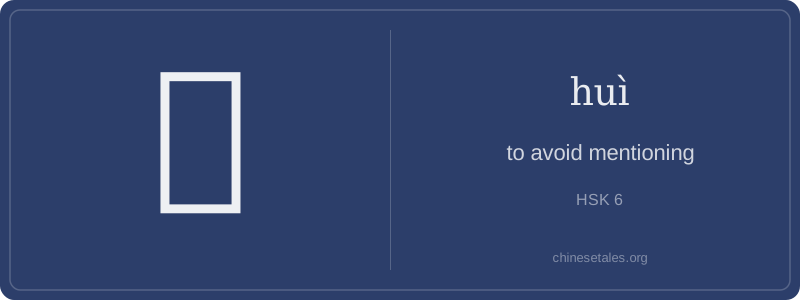
The earliest form of 讳 appears in bronze inscriptions as a compound: the left side was 言 (yán, ‘speech’), and the right was 韋 (wéi, ‘tanned leather’ — later simplified to 为). But here’s the twist: 韋 wasn’t just decorative — in ancient rituals, tanned leather wrapped sacred objects to conceal them from view. So the original character visually fused ‘speech’ + ‘covering/concealment’ — literally ‘to cover speech’. Over centuries, 韋 morphed into the streamlined 为 (wéi) we see today, and the left side solidified into the modern 讠 radical — preserving that core idea: language deliberately veiled.
This visual logic shaped its meaning: in the *Zuo Zhuan*, Confucius famously criticized historians who ‘讳而不书’ (huì ér bù shū, ‘concealed and omitted’) facts about rulers — showing how early 讳 carried moral weight, not just etiquette. By the Han dynasty, it governed imperial naming laws: writing Emperor Wen’s given name ‘Heng’ (恒) required substituting 恒 → 常. The character didn’t just describe avoidance — it *enforced* it. Even today, its six strokes feel lean and decisive: two for the speech radical (讠), four for the ‘cover’ (为), like a minimalist curtain drawn across a word.
Think of 讳 (huì) as Chinese culture’s version of the ‘elephant in the room’ — but instead of ignoring it, you actively tiptoe around its name. It’s not just ‘avoiding’; it’s a ritualized, almost reverent silence — like refusing to say your boss’s first name in front of senior colleagues, or skipping the word ‘death’ at a funeral and saying ‘passed on’ six times instead. This isn’t casual euphemism: it’s social grammar encoded in a single character.
Grammatically, 讳 functions almost exclusively as a verb, usually in formal or literary contexts, and nearly always with an object — e.g., 讳言 (huì yán, ‘to avoid speaking [of something]’) or directly followed by the taboo topic: 他讳谈政治 (tā huì tán zhèngzhì, ‘He avoids discussing politics’). You’ll rarely see it alone — unlike English ‘avoid’, which can stand freely, 讳 demands what you’re avoiding. Learners often mistakenly use it like 忌 (jì) or 避 (bì), but those imply general caution or physical evasion; 讳 is specifically about *linguistic suppression* — silencing the word itself.
Culturally, this traces back to ancient naming taboos (避讳 bì huì), where even writing the emperor’s given name was punishable. Today, it surfaces subtly: journalists may 讳报 (huì bào, ‘underreport’) sensitive incidents; doctors might 讳疾忌医 (huì jí jì yī, ‘hide illness and shun treatment’) — a four-character idiom still used to scold denialism. A common error? Using 讳 as a noun (‘a taboo’) — nope! That’s 忌 or 禁忌. 讳 is always the *act* of avoidance — the hush before the unsaid.