谎
Character Story & Explanation
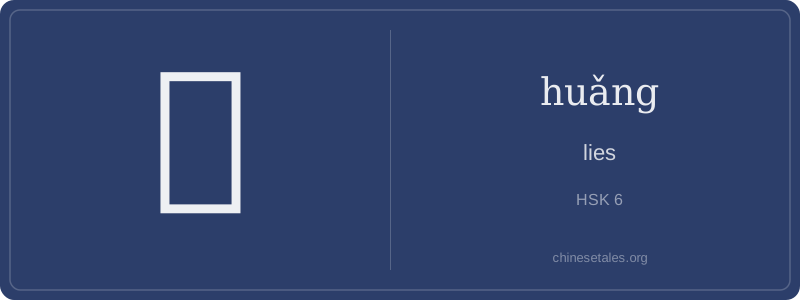
The earliest form of 谎 appears in late Warring States bamboo slips — not as a pictograph, but as a phono-semantic compound: the left side 讠 (speech radical) signals meaning related to language; the right side 荒 (*huāng*, 'wasteland, desolate') provides both sound and metaphorical depth. Originally written as 誤 (a different character), 谎 emerged around the Han dynasty as a specialized variant. Its 11 strokes evolved precisely: first the vertical stroke of 讠, then the four dots of 荒’s grass radical (艹), followed by the crossbar and downward stroke — visually echoing how a lie begins small (a dot) and spreads like unchecked weeds across fertile ground (the 'wasteland' of truth).
By the Tang dynasty, 谎 appears in Buddhist sutras warning against 'huǎng yǔ' (false speech) as one of the ten unwholesome deeds. In the Ming novel Jin Ping Mei, characters are repeatedly condemned for 'shuō huǎng chéng xìng' (lying habitually), linking the character to moral character, not just isolated acts. The visual pairing of 讠 + 荒 subtly reinforces this: speech that creates emotional or social barrenness — where trust once grew, now only emptiness remains.
Imagine a tense family dinner where your cousin, freshly back from studying abroad, insists he’s fluent in Mandarin — then stumbles over basic tones. When Auntie Li gently asks, 'Nǐ zhēn de huì shuō ma?' (Do you really speak it?), he flashes a nervous smile and says, 'Dāng rán! Wǒ cóng lái bù shuō huǎng!' — and the room goes quiet. That single word huǎng lands like a pebble dropped into still water: not just 'a lie', but a socially charged, morally weighted untruth told with intent to deceive. In Chinese, 谎 isn’t neutral like 'fib' or 'white lie'; it carries mild shame, moral weight, and often implies breach of trust.
Grammatically, 谎 is almost always a noun (e.g., 说谎 *shuō huǎng* 'to tell a lie'), rarely used alone as a verb. You don’t *huǎng* — you *shuō huǎng*, *sī huǎng* (fabricate), or *jiǎo huǎng* (cover up). Crucially, it’s never used adjectivally like English 'lying' — you’d say *xū jiǎ de huà*, not *huǎng de huà*. Learners often mistakenly use it as a verb stem (*huǎng le*) or confuse it with the more formal 假 (*jiǎ*) — but 谎 is colloquial, interpersonal, and emotionally loaded.
Culturally, calling someone a 'huǎng yán zhě' (liar) is serious — Confucian ethics treat honesty (*xìn*) as foundational to human relationships. Even in modern contexts, 'bù shuō huǎng' appears in school mottos and government slogans. A common error? Using 谎 for 'false information' in news contexts — that’s better rendered as 虚假信息 (*xūjiǎ xìnxī*). 谎 lives in mouths, not headlines.