譬
Character Story & Explanation
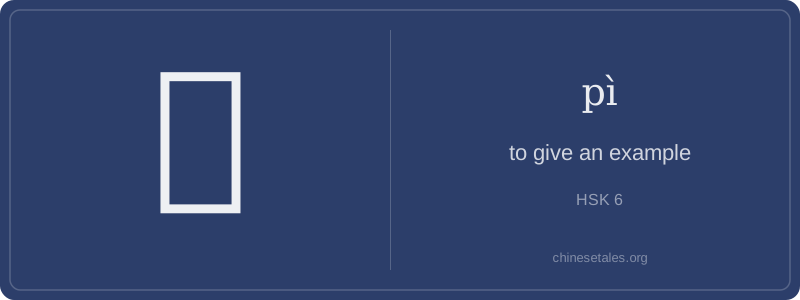
The earliest form of 譬 appears in bronze inscriptions as a compound: the left side was 言 (speech), and the right was 辟 (bì), which itself combined 巿 (a ceremonial garment) and 廾 (two hands holding something up) — originally depicting ritual purification or authoritative proclamation. Over centuries, 辟 simplified into its modern shape, and the whole character stabilized around the Han dynasty with the ‘speech’ radical anchoring its function: words used to *clarify through parallel*. Stroke by stroke, the top-right evolved from ceremonial gesture to the familiar 辟 shape — 20 strokes total, each one echoing the precision required to draw a meaningful comparison.
This visual logic mirrors its semantic journey: from ritual declaration → authoritative explanation → reasoned analogy. In the *Analects*, Confucius rarely uses 譬 directly, but Mencius masterfully deploys it — e.g., comparing human nature to water flowing downhill (‘人性之善也,猶水之就下也’), a classic 譬. The character’s very structure — speech + authoritative act — signals that analogy here isn’t casual; it’s a deliberate, truth-anchored rhetorical tool. Even today, seeing 譬 on the page feels like hearing a scholar clear their throat before delivering a luminous comparison.
At its heart, 譬 (pì) is the art of making the abstract click — not by definition, but by analogy. Think of it as linguistic bridge-building: you don’t explain ‘justice’ head-on; you say, ‘Justice is like a balanced scale.’ That’s 譬 in action — elegant, rhetorical, and deeply rooted in classical Chinese thought. It’s not casual: you won’t hear it in texting or spoken slang. It lives in essays, speeches, philosophical texts, and formal explanations — always introducing a *comparative illustration*, never just ‘for example’ (that’s 例如). Its tone is thoughtful, almost pedagogical.
Grammatically, 譬 most often appears in the fixed pattern 譬如 (pìrú) — ‘for instance’ or ‘as an analogy’ — usually at the start of a clause. Less commonly, it stands alone as a verb: 譬作 (pì zuò, ‘to liken to’) or 譬喻 (pìyù, ‘analogy’), where it functions as a bound morpheme. Learners often mistakenly substitute it for 例如 or 比如 — but those introduce *examples*, while 譬 introduces *analogies* with explanatory weight. Saying ‘譬如,他很懒’ sounds oddly literary and incomplete; it begs the question: *like what?* — because 譬 demands a comparative structure.
Culturally, 譬 reflects China’s long tradition of teaching through metaphor — from Confucius’s ‘The wise find joy in water; the virtuous find joy in mountains’ to modern policy white papers that ‘liken economic reform to pruning a growing tree.’ Misusing it risks sounding either archaic or mechanically textbook-ish. Native speakers reserve it for moments when clarity hinges on *relational insight*, not mere enumeration — a subtle but vital distinction.