岂
Character Story & Explanation
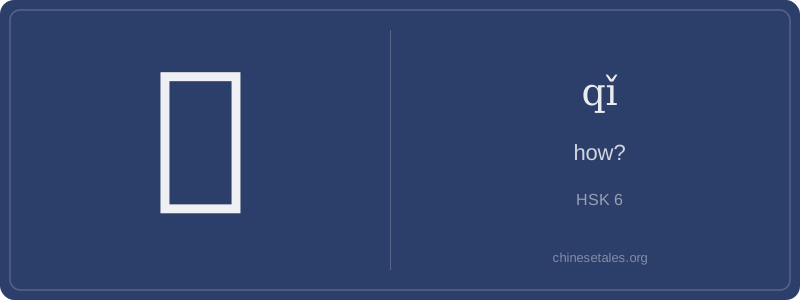
The earliest form of 岂 appears in bronze inscriptions as a stylized mountain (山) with a small, angular 'mouth-like' element above it — not literally a mouth, but a simplified representation of a ritual vessel or a ceremonial cover. Over time, the upper part evolved into the radical 己 (jǐ), which looks like a bent arm holding something — but crucially, it was never meant to be read as 己. Scribes gradually fused it with 山 (shān, 'mountain'), creating the modern six-stroke structure: 山 + 己. The mountain base remained stable, while the top morphed from ritual symbolism into an abstract marker of emphasis and questioning.
This visual evolution mirrors its semantic journey: from ancient ritual contexts where mountains symbolized cosmic authority and divine inquiry, 岂 came to embody elevated, authoritative doubt — 'How could Heaven allow this?' — a phrase echoing in texts like the *Zuo Zhuan* and echoed by Mencius when challenging unjust rulers. Its enduring power lies in that fusion: the grounded stability of 山 meets the assertive, questioning energy of the top component — a mountain asking you to reconsider reality.
Think of 岂 (qǐ) not as a flat 'how?' but as a raised eyebrow — the linguistic equivalent of a skeptical gasp. It’s a classical interrogative adverb, almost always appearing in rhetorical questions that expect a strong 'no' answer: 'How could this possibly be true?' or 'Would anyone seriously believe that?' It’s emphatic, elegant, and deeply literary — you’ll rarely hear it in casual speech, but it pulses through essays, editorials, and formal speeches like a quiet drumbeat of doubt.
Grammatically, 岂 always precedes a verb or adjective and pairs with negation — most often 不 (bù) or 非 (fēi), forming structures like 岂不…? ('How could it not…?') or 岂能…? ('How could one possibly…?'). For example: 岂能坐视不管?('How could we sit by and do nothing?') — notice how it transforms a simple question into a moral imperative. Learners often mistakenly treat it like modern 是吗?(shì ma?) and drop the required negation, resulting in ungrammatical, jarring sentences.
Culturally, 岂 carries the weight of classical Chinese logic and Confucian rhetorical tradition — it’s the character scholars used to dismantle flawed arguments with polite ferocity. A common mistake is overusing it in spoken Mandarin; native speakers reserve it for written persuasion or heightened speech. Also, never confuse its tone: qǐ (third tone) — not qí (second tone, like 'qi' in 'Qigong') — mispronouncing it makes it sound like another word entirely.