贤
Character Story & Explanation
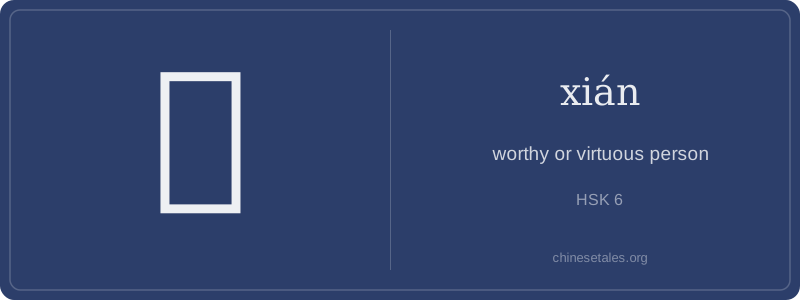
The earliest form of 贤 appears on Warring States bamboo slips as a compound: the top was 臤 (qiān), a phonetic component depicting a man (臣) holding a weapon (丿), suggesting 'one who commands rightly'; below was 貝 (bèi), the 'shell' radical — not for money, but because shells were ancient symbols of value, worth, and ritual exchange. Over centuries, 臤 simplified into 臤 → 贤, losing the weapon stroke and streamlining the man into two horizontal lines and a vertical, while 貝 retained its eight-stroke shell shape — making the full character literally 'valued person'.
This visual logic powered its meaning: in the Analects, Confucius praises Yan Hui as ‘the most 贤 among my disciples’ — not for scholarship alone, but for his poverty-enduring humility and unwavering virtue. The shell radical wasn’t decorative: it anchored 贤 to the idea that moral excellence is society’s highest currency. Even today, the eight strokes quietly echo that ancient equation: human dignity + social worth = 贤.
At its heart, 贤 isn’t just ‘virtuous’ — it’s a Confucian seal of approval. It doesn’t describe abstract goodness, but *socially recognized moral excellence*: someone whose wisdom, humility, and benevolence earn respect from elders, rulers, and peers alike. Think less ‘saintly’ and more ‘the kind of person you’d appoint as minister or entrust with your child’s education’. That’s why it almost never stands alone in speech — you’ll rarely hear ‘He is 贤’; instead, it’s embedded in titles (贤士, 贤人) or comparative structures (更贤, 不贤).
Grammatically, 贤 behaves like an adjective but resists casual modification: no ‘very 贤’ (很贤 sounds unnatural), no ‘a little 贤’. It’s either present (贤明的君主 — a wise ruler) or absent — a binary weightiness that reflects classical Chinese values. Learners often overuse it like English ‘worthy’, missing its elevated, almost ceremonial register. You wouldn’t call your kind neighbor 贤 — you’d say 好心 or 善良. 贤 belongs in essays, historical dramas, and speeches about leadership.
Culturally, 贤 carries the quiet pressure of meritocracy: in imperial China, passing the civil exams didn’t just mean ‘smart’ — it meant *xian*, embodying the ideal scholar-official. Today, calling someone 贤 still implies they’ve earned moral authority through action and integrity — not just good intentions. A common slip? Using 贤 when you mean ‘capable’ (能干) or ‘excellent’ (优秀); those are practical strengths, while 贤 is fundamentally ethical stature.