赌
Character Story & Explanation
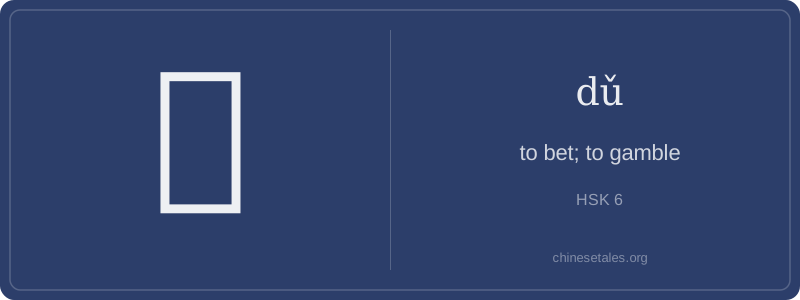
The earliest form of 赌 appears in Han dynasty clerical script — not oracle bone, but still ancient — where it combined 貝 (bèi, ‘shell’, ancient currency) on the left with 者 (zhě, ‘person/agent’) on the right. Over centuries, 者 evolved: its top stroke became the horizontal line above the ‘dot-and-hook’ shape, the middle simplified into two parallel strokes, and the bottom transformed from ‘old man’s staff’ into the modern 者’s distinctive 12-stroke structure. Crucially, the ‘shell’ radical stayed — anchoring the meaning in material value, not abstract chance.
This visual logic reflects its historical function: in classical texts like the Shuōwén Jiězì (c. 100 CE), 赌 was defined as ‘to contend for profit with wealth as stake’. It wasn’t about dice or cards originally — it described merchants wagering goods, generals betting territory in treaties, or scholars staking prestige in poetic contests. By the Ming dynasty, novels like Water Margin used 赌 to depict underground gambling dens — and the character’s sharp, angular strokes (especially the aggressive downward hook in 者) began echoing the tension of high-stakes confrontation. Even today, its 12 strokes feel deliberately unbalanced — like a bet teetering on the edge of win or ruin.
At its heart, 赌 (dǔ) isn’t just ‘to gamble’ — it’s the visceral tension of risking something real: money, reputation, even one’s future. Unlike English ‘bet’, which can be playful (‘I bet you’ll love this movie’), 赌 carries weight and consequence in Chinese — it implies stakes, agency, and often moral ambiguity. You’ll rarely hear it used lightly; even in sports commentary, saying 他赌对了 (tā dǔ duì le, ‘he gambled correctly’) suggests a high-risk, high-reward strategic call, not a lucky guess.
Grammatically, 赌 is a transitive verb that *requires* an object — you don’t just ‘gamble’, you 赌钱 (dǔ qián, ‘bet money’), 赌命 (dǔ mìng, ‘risk your life’), or 赌上尊严 (dǔ shàng zūnyán, ‘stake your dignity’). A classic mistake? Omitting the object or using it intransitively like English — ‘He gambles every weekend’ must become 他每个周末都赌钱 (tā měi gè zhōumò dōu dǔ qián). Also note: 赌 is almost never used as a noun by itself — for ‘a bet’, you say 打赌 (dǎ dǔ) or 赌注 (dǔzhù), not *赌.
Culturally, 赌 triggers immediate associations with prohibition and social caution: China bans most gambling (except state lotteries and Macau casinos), so the character appears frequently in anti-gambling campaigns (禁赌, jìn dǔ) and legal warnings. Learners sometimes overuse it trying to sound idiomatic — but native speakers reach for synonyms like 押 (yā, ‘to stake’) or 冒险 (màoxiǎn, ‘to take a risk’) when tone or context calls for nuance. Remember: 赌 always smells faintly of smoke, sweat, and consequence.