蹈
Character Story & Explanation
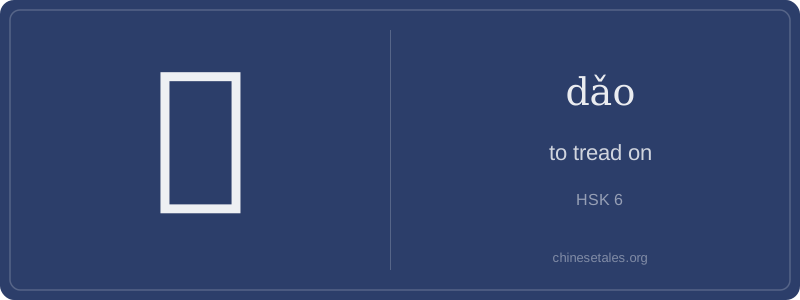
The earliest form of 蹈 appears in Warring States bamboo slips as a complex pictograph: a foot (足) stepping down onto a 'path' or 'track' (originally resembling a curved line or repeated strokes suggesting repetition), with an added 'hand' or 'tool' component (now obscured in the modern top-right 肖) hinting at ritual action. Over centuries, the 'path' element evolved into the phonetic component 肖 (xiāo), while the foot radical 足 remained firmly anchored at the bottom — a visual anchor that never wavered. By the Han dynasty clerical script, the structure solidified: 17 strokes, with the foot clearly bearing the weight of the entire character — both literally and semantically.
This visual grounding shaped its semantic journey. Originally linked to ritual dance steps — the kind performed by Zhou dynasty court musicians who 'trod the rites' (蹈禮) — 蹈 gradually shed its performative connotation and absorbed moral and cautionary force. Mencius wrote of 'treading the way of Yao and Shun' (蹈堯舜之道), turning movement into ethical alignment. Later, in Tang poetry and Song essays, it became synonymous with conscious emulation or perilous commitment — always implying agency, consequence, and precedent. Even today, when Chinese writers say someone 'treads on the tail of a tiger' (蹈虎尾), they’re not describing hiking boots — they’re invoking the I Ching’s warning about reckless ambition.
At its core, 蹈 (dǎo) means 'to tread on' — but not casually like stepping on a rug. It’s deliberate, often solemn or even perilous: treading on thin ice, treading the path of sages, or treading into danger. The character radiates weight and intention; it rarely appears in everyday strolling contexts (that’s 走 or 散步). Instead, it’s literary, formal, and frequently metaphorical — think 'treading new ground' or 'treading the line between loyalty and rebellion'.
Grammatically, 蹈 is almost never used alone. It’s bound to nouns in compound verbs like 蹈火 (dǎo huǒ, 'to tread fire' → 'to brave extreme danger') or appears in set phrases such as 重蹈覆辙 (chóng dǎo fù zhé, 'to tread again the old rut' → 'to repeat a past mistake'). Learners often mistakenly try to use it transitively with objects ('I tread the floor'), but native usage demands abstraction or idiom — you don’t 蹈 the floor; you 踩 the floor. Also beware: 蹈 is *never* used for dancing in modern Mandarin (that’s 跳), though its ancient roots are entwined with ritual dance — a key source of confusion.
Culturally, 蹈 carries classical gravitas. In Confucian texts, it evokes moral precedent: 'treading the path of the ancients' (蹈古) signals reverence for tradition. Mistaking it for a neutral verb leads to awkward, archaic-sounding sentences. And crucially — unlike many HSK 6 characters, 蹈 has *zero* colloquial spoken frequency. You’ll see it in essays, editorials, and historical novels, but almost never hear it in casual speech. That’s why mastering its idiomatic habitat matters more than memorizing its dictionary definition.