蹦
Character Story & Explanation
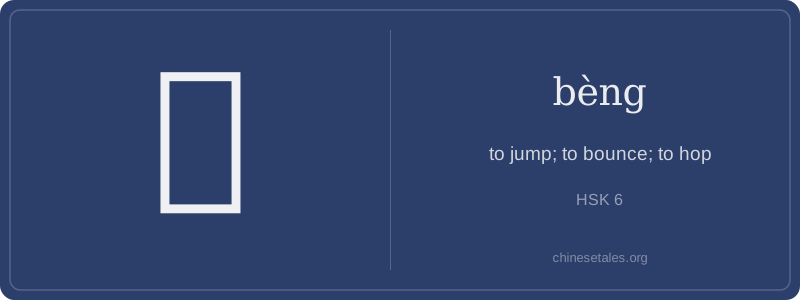
The earliest form of 蹦 doesn’t survive in oracle bone script, but its structure reveals ancient logic: left side 足 (zú, 'foot') anchors the meaning in locomotion; right side is 崩 (bēng, 'to collapse, burst, crumble') — not as destruction, but as *sudden release of pent-up force*. Imagine a tightly coiled spring snapping — that’s the visual metaphor encoded in the bronze and seal script evolution: the radical stabilized while the phonetic component 崩 grew more stylized, its mountain-like strokes (山) and collapsing earth (冫+朋) transforming into today’s elegant but energetic 18-stroke form.
This ‘bursting foot’ idea crystallized during the Han dynasty, appearing in early dictionaries like the Shuōwén Jiězì as a verb for ‘leaping with recoil’. By the Ming-Qing vernacular novels, 蹦 became associated with lively, unrefined movement — contrasted with the dignified stride of scholars or the measured leaps of martial artists. Its sound, bèng, mimics the sharp, percussive pop of impact — making it one of Chinese’s most sonically embodied verbs. Even today, when you write those 18 strokes, you’re tracing the arc of kinetic energy: compression → explosion → lift.
At its heart, 蹦 isn’t just ‘jump’ — it’s *explosive*, *uncontainable* motion: think a startled rabbit leaping sideways, a toddler bouncing off the walls, or a basketball hitting concrete and ricocheting wildly. Unlike generic 跳 (tiào), which covers most jumping, 蹦 emphasizes vertical bounce, rhythmic hopping, or sudden, springy recoil — often with lightness, playfulness, or even nervous energy. It’s visceral, onomatopoeic, and deeply physical.
Grammatically, 蹦 is almost always used as a verb — but rarely alone. It loves reduplication (蹦蹦跳跳) for vivid, iterative action; appears in compound verbs like 蹦高 (bèng gāo, 'jump high') or 蹦迪 (bèng dí, slang for 'go clubbing'); and frequently pairs with 跳 in fixed phrases (蹦跳, 蹦蹦跳跳). Learners often mistakenly use it where 跳 suffices — e.g., saying *我蹦上车* instead of *我跳上车* — which sounds comically bouncy, like you’re vaulting onto the bus like a pogo stick.
Culturally, 蹦 carries youthful, unstructured vitality. In classical texts, it’s rare — but in modern usage, it’s everywhere: from children’s rhymes (*小兔子蹦蹦跳*) to internet slang (*蹦迪* for clubbing, evoking rhythmic, body-shaking movement). Note: it’s almost never used for solemn or graceful leaps (e.g., ballet dancers *跳* — never *蹦*). And yes — that 18-stroke complexity? It’s earned: every stroke mirrors tension, recoil, and propulsion.