躬
Character Story & Explanation
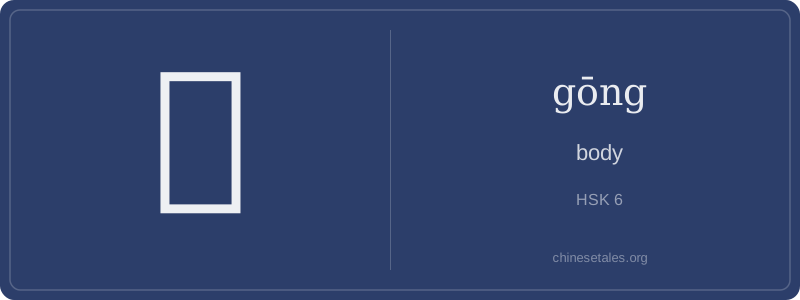
The earliest form of 躬 appears in bronze inscriptions as a stylized human figure with an exaggerated, curved torso and bent knees—literally ‘a body bending forward’. The top part was originally a head and arms; the lower part, a crouching leg and foot. Over time, the upper element fused into the ‘弓’ (gōng, bow) shape—*not because it means ‘bow’*, but because the curve of the bent spine resembled a drawn bow. Meanwhile, the ‘身’ (shēn, body) radical anchored the meaning, evolving from a full-figure pictograph to today’s simplified torso-with-arms. So visually, 躬 is ‘the body shaped like a bow’—a perfect image of humility, effort, or readiness.
This visual metaphor deepened philosophically: in the Analects and Mencius, ‘gōng’ became synonymous with personal accountability—bending your own body to labor, to serve, or to reflect. The ‘bow-like’ posture wasn’t just physical; it signaled sincerity. Even today, 躬身 (gōng shēn) doesn’t just mean ‘bend down’—it implies respect so profound it reshapes your posture. That ancient curve lives on in every HSK 6 essay about moral cultivation.
At its heart, 躬 (gōng) isn’t just ‘body’ in the anatomical sense—it’s the *whole self as present, engaged, and embodied*. Think of it as the Chinese linguistic equivalent of ‘showing up in person’—not just physically, but with full moral and emotional weight. In classical texts, it often appears reflexively: 躬行 (gōng xíng) means ‘to personally carry out’, not merely ‘to do’, but to do *with your own hands and heart*. That nuance is vital: you don’t ‘have’ a 躬—you *are* your 躬 when you act authentically.
Grammatically, 躬 is almost never used alone in modern speech—it’s a literary, formal, or compound-only character. You’ll rarely hear someone say ‘my body’ as *wǒ de gōng*; instead, it’s tightly bound in set phrases like 躬身 (bend the body → show humility) or 反躬自问 (fǎn gōng zì wèn → ‘turn one’s body inward to ask oneself’: introspection at its most visceral). Learners often mistakenly treat it like a neutral noun like 身体 (shēntǐ), but that’s like using ‘thine’ instead of ‘your’ in casual English—it instantly marks your register as archaic or ceremonial.
Culturally, 躬 carries Confucian gravity: Mencius wrote of ‘gōng shēn ér hòu néng zhèng rén’ (‘only after rectifying one’s own body can one correct others’)—where ‘body’ means conduct, posture, integrity. A common error? Using 躬 where 身 is expected (e.g., *gōng tǐ* instead of *shēn tǐ* for ‘physical body’). Remember: 躬 is the *acting*, *bearing*, *performing* body—not the biological one.