意
Character Story & Explanation
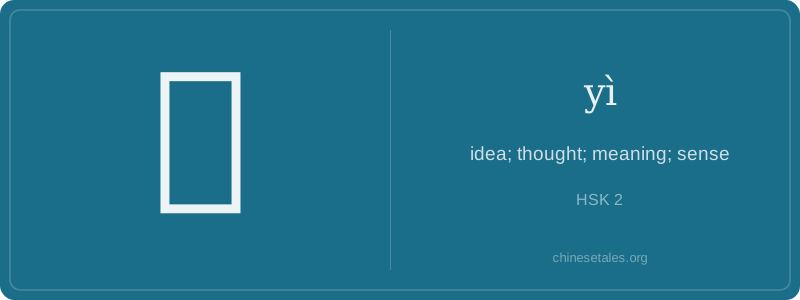
The earliest form of 意 appears in bronze inscriptions as a combination of 音 (yīn, ‘sound’) above and 心 (xīn, ‘heart’) below — no mouth, no brain, just sound resonating *within* the heart. The top part wasn’t abstract: it depicted a bell-shaped musical instrument with a clapper, symbolizing resonance, vibration, and internal response. Over centuries, 音 simplified into 亠 + 日 + 一 + 心 — but the core idea held: meaning arises not from external logic, but from the heart’s resonance with experience. By the Han dynasty, the character had stabilized into its current 13-stroke form, with the ‘roof’ radical (亠) sheltering the ‘sun’ (日), ‘horizontal line’ (一), and ‘heart’ (心) beneath.
This visual logic shaped its philosophical depth. In the Zhuangzi, 意 describes the mind’s spontaneous, unforced awareness — ‘the intention before intention’. Confucius spoke of ‘intentions aligned with virtue’ (意誠), linking inner resolve to moral action. Even today, the character’s structure whispers its truth: meaning isn’t imposed — it’s what rises, sun-like, from the heart’s quiet chamber. No wonder poets wrote of ‘a thousand meanings in one glance’ — all born in the 心.
At its heart, 意 isn’t just ‘idea’ — it’s the quiet hum of inner awareness: the flicker before speech, the unspoken weight behind a glance, the intention that shapes action. In Chinese thought, 意 lives in the heart-mind (心), not the head alone — reflecting the classical view that cognition and feeling are inseparable. That’s why you’ll hear 意思 (yì si) — literally ‘intention + thought’ — used constantly for ‘meaning’ or ‘what someone means’, even in casual speech like ‘你是什么意思?’ (What do you mean?)
Grammatically, 意 rarely stands alone in modern speech (unlike English ‘idea’); it’s almost always in compounds or set phrases. You won’t say *‘wǒ yǒu yì’* — instead, you say 我有意思 (wǒ yǒu yì si, ‘I’m interested’) or 我无意中… (wǒ wú yì zhōng…, ‘unintentionally…’). Notice how it pairs with particles like 无 (wú, ‘without’) or 有 (yǒu, ‘to have’) to form nuanced adverbial expressions — a pattern learners often miss when translating word-for-word.
Culturally, 意 carries subtle moral gravity: 意志 (yì zhì, ‘willpower’) implies disciplined resolve; 好意 (hǎo yì, ‘good intention’) can soften criticism (‘I know it’s well-meaning…’). A common mistake? Using 意 alone where English uses ‘idea’ — e.g., saying *‘tā de yì hěn hǎo’* instead of the natural 我觉得他的主意很好 (tā de zhǔ yì hěn hǎo, ‘his suggestion is great’). Remember: 意 is the inner spark — but the world needs a noun like 主意 or 想法 to hold it.