辕
Character Story & Explanation
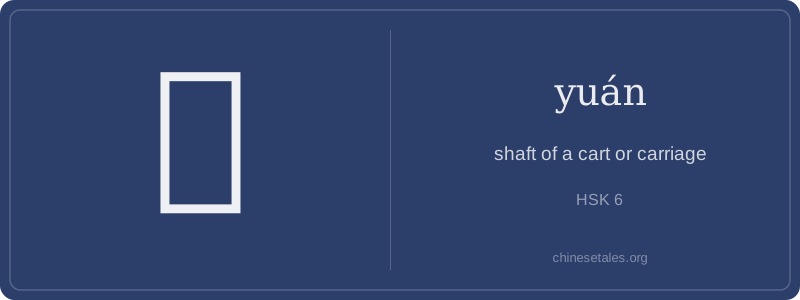
The earliest form of 辕 appears in Warring States bamboo texts and Han dynasty seals: a left-side 车 (carriage) radical, paired with 口 (mouth) and two parallel horizontal strokes above it — representing the straight, rigid wooden shaft extending forward from the cart body. Over time, 口 evolved into the top component 元 (yuán), which originally meant ‘head’ or ‘first,’ reinforcing the idea of the shaft as the leading, foremost structural element. The four dots (灬) at the bottom? Actually a stylized variant of 火 (fire), but here they’re purely decorative — a late clerical script flourish that stabilized into today’s 14-stroke form.
This character was already highly technical by the Spring and Autumn period: the *Zuo Zhuan* describes chariots ‘with polished yuán’ before battle, and Sima Qian’s *Records of the Grand Historian* notes how broken yuán halted entire armies. Its visual logic is brilliant — the ‘head’ (元) atop the ‘vehicle’ (车) literally shows the shaft as the cart’s commanding front. Even today, when writers say ‘执辕’ (zhí yuán, ‘to hold the shaft’), they mean ‘to take command’ — proving this humble wood beam never lost its metaphorical weight.
Picture a sleek, ancient war chariot thundering across the Central Plains — and there, right at its heart, is the yuan: the central wooden shaft that connects the yoke to the axle, bearing the full pull of horses. That’s 辕: not just ‘a part of a cart,’ but the structural and symbolic spine of pre-modern Chinese transport. It feels authoritative, grounded, even slightly archaic — like a word you’d find carved on a bronze ritual vessel or quoted in a Tang dynasty poem about military campaigns.
Grammatically, 辕 is almost always a noun and rarely stands alone; it appears in compounds (like 车辕 or 炮辕) or poetic/metaphorical phrases. Learners sometimes try to use it as a verb ('to yoke' or 'to harness'), but no — it’s strictly nominal. You’ll see it in classical idioms like ‘改辕易辙’ (gǎi yuán yì zhé), meaning ‘to change course radically’ — literally ‘change the shaft and switch the ruts.’ Note how the shaft (辕) symbolizes direction itself!
Culturally, 辕 evokes imperial logistics, frontier defense, and classical mobility — think of the Silk Road caravans or Zhuge Liang’s supply carts. Modern usage is rare outside fixed expressions or historical writing, so using it conversationally sounds oddly literary or jarringly formal. A common mistake? Confusing it with 袁 (a surname) or 源 (‘source’) — both sound similar but share zero semantic ground with cart physics!