辱
Character Story & Explanation
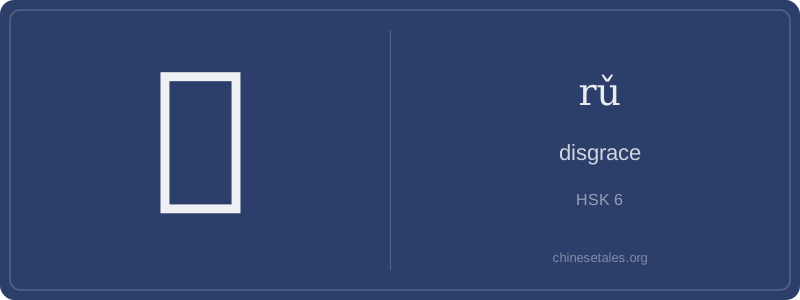
The earliest form of 辱 appears on Shang dynasty oracle bones as a composite pictograph: upper part resembled ‘辰’ (chén, a digging tool or celestial marker), lower part was ‘寸’ (cùn, hand) gripping something — possibly grain stalks or a symbolic object. Scholars debate whether it originally depicted ‘harvesting with improper tools’ (implying incompetence → shame) or ‘a hand violating sacred time’ (辰 also linked to ritual timing). By the Warring States period, the form stabilized into today’s structure: 辰 (radical, top) + 寸 (hand, bottom), losing its pictorial clarity but gaining semantic abstraction — the ‘hand’ acting *against cosmic or social order’ encoded in 辰.
This visual logic hardened over time: 辰 wasn’t just ‘time’ — in ancient cosmology, it represented the Dragon Star’s position, governing agricultural rites and imperial legitimacy. To ‘act with the hand against 辰’ thus meant disrupting sacred harmony — a profound moral failing. Hence, in the Book of Rites (Lǐjì), 辱 describes violations of ritual propriety (lǐ), like a son speaking harshly to parents. Even Mencius wrote ‘不辱其身’ (bù rǔ qí shēn, ‘do not disgrace one’s body’), tying physical conduct to moral integrity. The character’s quiet shape hides a thunderclap of ethical consequence.
At its core, 辱 (rǔ) isn’t just ‘disgrace’ — it’s the visceral sting of *social face loss*: public shame that damages reputation, honor, or moral standing. Unlike generic words for ‘bad’ (e.g., 坏), 辱 carries weighty Confucian gravity — it implies a violation of duty, trust, or decorum. Think less ‘oops’ and more ‘you’ve shamed your ancestors.’ It’s almost always used in formal, literary, or emotionally charged contexts: never in casual texting like ‘I’m embarrassed,’ but in speeches, historical texts, or solemn declarations.
Grammatically, 辱 is primarily a verb (‘to disgrace’) or a noun (‘disgrace’), rarely an adjective. It often appears in compound verbs like 辱没 (rǔ mò, ‘to tarnish’) or with classical particles: e.g., ‘辱赐’ (rǔ cì, ‘I am honored — literally, ‘you deign to bestow upon me,’ using 辱 as a humble verb). Learners mistakenly use it where English says ‘embarrassed’ — but 惭愧 (cánkuì) or 尴尬 (gāngà) fit everyday awkwardness; 辱 belongs to court trials, diplomatic protests, or filial crises.
Culturally, 辱 triggers deep resonance with ‘face’ (miànzi) and ‘honor-shame’ ethics. In classical usage, even accepting charity could be 辱 if done without proper ritual humility. A common error? Overusing it in spoken Chinese — it sounds archaic or melodramatic outside formal writing or set phrases like 奇耻大辱 (qí chǐ dà rǔ, ‘unspeakable humiliation’). Also, note its passive nuance: 辱 is often endured, not inflicted — the subject is usually the one *suffering* disgrace, not causing it (that’s more 咎 or 罪).