逢
Character Story & Explanation
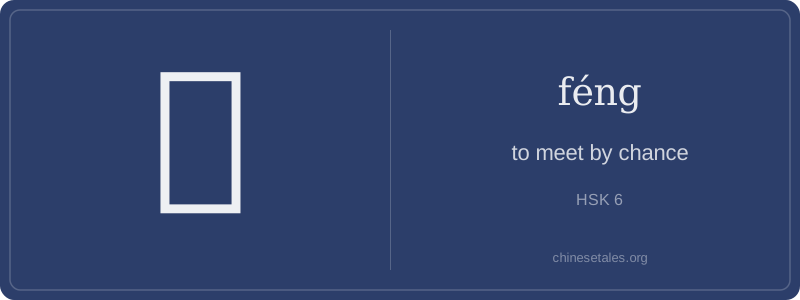
The earliest form of 逢 appears in bronze inscriptions as a composite: a walking person (辵, later simplified to 辶) approaching a stylized 'wind' or 'rising breath' element (夆, pronounced fēng), which itself evolved from a pictograph of a banner fluttering atop a pole — symbolizing movement, arrival, and visibility. Over centuries, the banner became 夆 (a phonetic component meaning 'to rise'), then simplified to 夅 + 廾, and finally fused with the 'walking radical' 辶 on the left. Crucially, the bottom part isn’t 冄 (rǎn) — a frequent learner error — but a stylized gesture of opening arms or unfolding, reinforcing the idea of mutual, open reception.
This visual logic deepened in classical usage: in the *Zuo Zhuan*, 逢 describes rulers meeting 'as Heaven ordained'; in Du Fu’s poetry, it evokes fated reunions after war’s scattering. The character never meant 'to find' (找) or 'to search' (寻) — it’s passive yet intentional, like moonlight falling where you happen to stand. Its elegance lies in that paradox: motion (辶) + resonance (夆) = chance made meaningful.
At its heart, 逢 (féng) isn’t just ‘to meet’ — it’s the electric spark of *unplanned encounter*: bumping into an old friend at a Kyoto temple gate, spotting your professor in a Shanghai night market, or stumbling upon the perfect antique while wandering aimlessly. It carries serendipity, fate, and gentle inevitability — never obligation or schedule. Unlike 见 (jiàn, neutral 'to see') or 遇 (yù, broader 'to encounter'), 逢 implies poetic resonance: two paths converging as if guided by invisible strings.
Grammatically, 逢 is elegant but picky. It’s almost always transitive and formal — you 逢 someone or something, not *a place* (you’d use 到 or 碰见 for locations). It thrives in literary and written contexts: essays, poetry, news headlines ('逢暴雨' — 'hit by heavy rain'), and fixed expressions like 适逢 ('just happened to coincide with'). Learners often misapply it in speech — saying *Wǒ féng le tā zuótiān* sounds like quoting a Tang dynasty poem at a coffee shop. Use it sparingly, deliberately, and with a quiet smile.
Culturally, 逢 echoes classical Daoist and Buddhist ideas of wu wei (effortless action) — meeting without seeking, arriving without planning. A common pitfall? Confusing it with 缝 (fèng, 'seam') — same sound family, totally different world. Also, don’t force it into compound verbs like *féng-zhe* (that’s reserved for 遇见); 逢 stands tall alone or in set phrases. Its power lies in its restraint — like a single ink stroke that holds the whole landscape.