遮
Character Story & Explanation
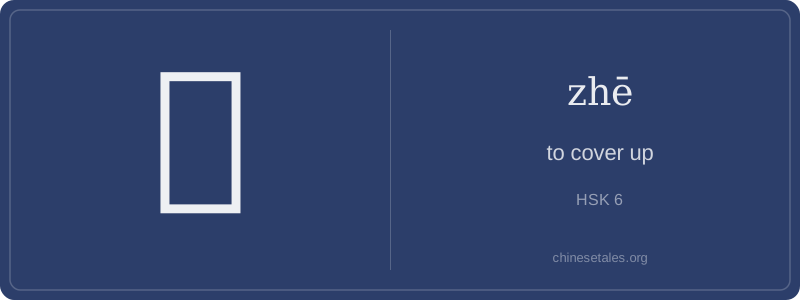
The earliest form of 遮 appears in seal script as a combination of 辵 (chuò, later simplified to 辶 — the ‘walking’ radical) on the left and 庶 (shù) on the right. 庶 itself evolved from an oracle bone pictograph showing a fire under a roof — symbolizing ‘numerous’ or ‘common people’, but by the Warring States period, it had acquired connotations of ‘dispersal’ and ‘obscuration’. When fused with 辶 (suggesting movement *toward* or *alongside* something), the character implied motion that brings something into concealment — like walking up to drape cloth over an object.
By the Han dynasty, 遮 solidified into its modern structure: 辶 + 庶. Its meaning sharpened from general ‘obstruction’ to intentional ‘covering up’, appearing in early medical texts (e.g., Huangdi Neijing) describing how wind pathogen ‘shields’ the body’s defensive qi. In Tang poetry, Du Fu used 遮 to depict mist veiling mountains — not just covering, but *softly erasing boundaries*. The radical 辶 doesn’t mean ‘walking’ here literally; rather, it signals *dynamic action*: the act of moving something into place to obscure — making 遮 uniquely kinetic among Chinese cover-verbs.
At its core, 遮 (zhē) isn’t just ‘to cover’ — it’s to deliberately obscure, conceal, or block from view, often with intentionality and sometimes even a hint of evasion. Think of pulling a curtain shut, hiding evidence, or shielding someone from harsh light or truth. Unlike neutral verbs like 盖 (gài, ‘to cover’ something physically, like a pot lid), 遮 implies agency and purpose: you *choose* to hide, shield, or veil — whether for protection (遮阳) or discretion (遮掩错误).
Grammatically, 遮 is almost always transitive and pairs naturally with objects that are visual, spatial, or metaphorical: light (阳光), truth (真相), flaws (缺点), or identity (面目). It frequently appears in compound verbs like 遮盖, 遮掩, or 遮蔽, and in passive constructions (被遮住) or result complements (遮住了). A common learner trap? Using 遮 where 蔽 or 挡 would sound more natural — e.g., saying *遮门* instead of 挡门 (‘block the door’) — because 遮 emphasizes *visual obstruction*, not physical blocking.
Culturally, 遮 carries subtle moral weight: classical texts like the Mencius use 遮 to critique hypocrisy — ‘遮其恶而扬其善’ (conceal one’s faults while promoting one’s virtues). Modern usage reflects this nuance: 遮丑 (zhē chǒu, ‘cover up ugliness’) is a biting idiom for institutional spin. Learners often overuse it in speech when simpler verbs like 盖 or 挡 would be more colloquial — remember: 遮 feels literary, deliberate, and slightly solemn.