懂
Character Story & Explanation
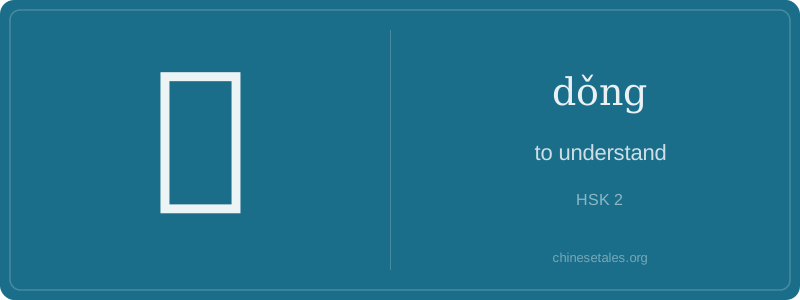
The earliest form of 懂 appears in Han dynasty clerical script — not oracle bone, but already richly evolved. Its left side 忄 (the ‘heart-mind’ radical) anchors it in emotion and cognition; the right side originally resembled 重 (zhòng, ‘heavy’), but simplified over centuries into 重’s cursive variant — now written as 重 in modern 懂. This wasn’t random: ancient scribes linked deep understanding with mental ‘weight’ — the gravity of insight, the heft of wisdom settling in the heart-mind. Every stroke tells a story: the three dots of 忄 pulse like a heartbeat; the top of 重 mimics a person bending under load (the ‘person’ radical 亻 plus ‘east’ 東 as phonetic/semantic hint); the lower part 尤 adds emphasis — suggesting something profound, exceptional.
By the Tang dynasty, 懂 was firmly established in texts like the *Guangyun* rhyme dictionary as ‘to comprehend thoroughly, to fathom the essence.’ Classical usage often paired it with moral insight — e.g., ‘懂礼’ (understand ritual propriety) — revealing how Chinese thought ties cognition to ethics and social harmony. The character’s visual weight mirrors its semantic depth: you don’t skim-learn 懂; you absorb it, feel it, carry it — just like the ‘heavy’ component suggests.
At its heart, 懂 isn’t just ‘to understand’ — it’s the quiet click of mental alignment, the moment a concept settles into place with warmth and recognition. Unlike English’s neutral ‘get it,’ 懂 carries emotional weight: it implies empathy, shared perspective, or even intimacy (e.g., 你懂我 means ‘you *truly get me*’ — not just intellectually, but emotionally). It’s rarely used in isolation; you’ll almost always see it after a subject + object: 我懂这个道理 (I understand this principle), never *‘I 懂’* alone.
Grammatically, 懂 is a simple transitive verb — no particles like 了 or 过 needed for basic past meaning (it’s inherently perfective: 我懂了 means ‘I’ve grasped it,’ not ‘I’m understanding’). Learners often mistakenly add 是 before it (*‘是懂’*) or confuse it with passive constructions — but 懂 has no passive form and never takes 是 as a copula. Also, it doesn’t take aspectual complements like 着 or 完 — its meaning is complete in itself.
Culturally, 懂 reflects the Confucian value of mutual resonance (mò qì 默契): true understanding is silent, intuitive, and relational — not just factual recall. That’s why saying ‘我不懂’ (I don’t understand) can sound humble or even apologetic, while ‘你不懂’ may gently signal a gap in shared worldview — not ignorance, but a lack of shared experience. Misusing it as a noun (e.g., *‘a 懂’*) or forcing it into English-style progressive tenses trips up many beginners.