郎
Character Story & Explanation
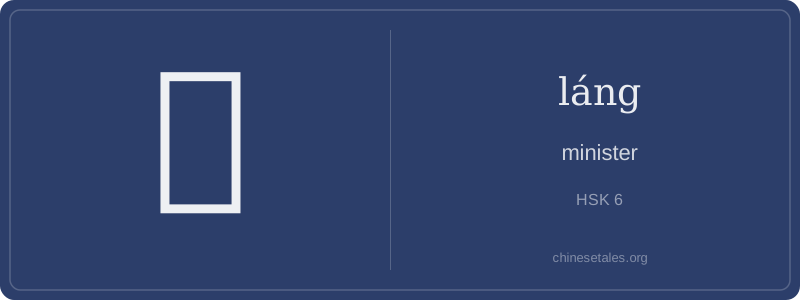
The earliest form of 郎 appears on Warring States bamboo slips, not oracle bones — and it’s a masterpiece of semantic fusion. The left side was originally 良 (liáng), meaning 'good, fine, excellent', drawn with a roof-like top and two horizontal strokes beneath. The right side was 阜 (fù), the old form of 阝 (the 'mound' or 'hill' radical), representing a raised earthen platform — symbolizing a place of prominence or official residence. Together, they evoked 'a person of excellence stationed at an elevated post': literally, 'one who dwells on the noble mound'.
By the Han dynasty, 郎 solidified as a specific bureaucratic rank — young men of good family serving as imperial attendants or guards, often stepping stones to higher office (like Sima Qian’s father, who held the title 太史令, but many 郎 served under him). This elite, youthful connotation bled into literature: in the famous poem Shuǐ Diào Gē Tóu, Su Shi writes '不知天上宫阙,今夕是何年?我欲乘风归去,又恐琼楼玉宇,高处不胜寒。起舞弄清影,何似在人间?转朱阁,低绮户,照无眠。不应有恨,何事长向别时圆?人有悲欢离合,月有阴晴圆缺,此事古难全。但愿人长久,千里共婵娟。' — while 郎 doesn’t appear there, its cultural cousins like 郎君 permeate Tang-Song love poetry as tender, respectful vocatives for beloved men.
At first glance, 郎 (láng) feels like a formal, almost archaic word — and it is! Its core meaning is 'minister' or 'official', especially in classical contexts like ‘侍郎’ (shì láng, vice-minister), but don’t let that fool you: today it’s far more alive in personal, even affectionate, usage. In modern spoken Chinese, 郎 appears most often in romantic or familial terms — think 郎君 (láng jūn, 'my dear husband') or 少年郎 (shào nián láng, 'youthful young man'). It carries warmth, dignity, and a subtle poetic flair, never cold bureaucracy.
Grammatically, 郎 rarely stands alone as a noun; it’s almost always bound — either as the second character in compound nouns (e.g., 令郎, lìng láng, 'your esteemed son') or in fixed honorifics. Crucially, it’s never used for oneself (no *wǒ láng!), only when addressing or referring to others respectfully — making it a classic example of Chinese’s intricate 'face'-conscious grammar. Learners often misapply it as a generic 'man' (like English 'guy'), but 郎 isn’t casual slang — it’s layered with deference or literary charm.
Culturally, 郎 is a time-traveler: from Han dynasty court ranks to Tang poetry’s gallant youths to today’s pop lyrics calling someone ‘heartthrob’ (小鲜肉 + 郎 energy). A common mistake? Confusing it with 良 (liáng, 'good') — same top, different bottom — or overusing it where younger speakers would say 男生 (nán shēng) or 先生 (xiān sheng). Remember: 郎 doesn’t just name a role — it bestows a gentle, lyrical status.