郑
Character Story & Explanation
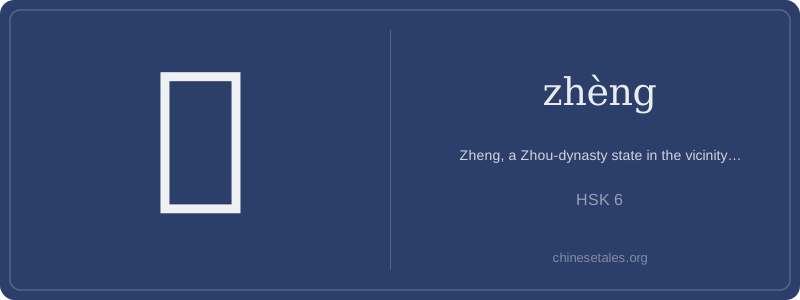
The earliest form of 郑 appears on Warring States bronze inscriptions as a compound: the left side was a stylized version of 关 (guān, 'to lock' or 'barrier'), representing a fortified gate or checkpoint; the right side was 邑 (yì, 'city'), later simplified to the 'right ear radical' 阝. This combination literally meant 'the walled city of Guān' — referring to the fief granted to Duke Huan of Zhou’s younger brother in the early 8th century BCE near present-day Xinzheng. Over time, the left component evolved from 关 to a more compact form resembling 丷 + 口, while the right retained its city-related meaning — yielding today’s eight-stroke 郑.
By the Spring and Autumn period, the State of Zheng became a diplomatic powerhouse — small but shrewd, known for its treaties and legal codification. Confucius himself praised Zheng’s music as 'harmonious yet solemn' (《论语》: '郑声淫' — though this phrase is often misquoted; he actually criticized its *excess*, implying the ideal lay in its original balanced dignity). The character thus transformed from a toponym into a surname carried by descendants of the ruling clan — and eventually, into one of China’s top 20 surnames, carrying forward that ancient aura of measured authority.
At first glance, 郑 (zhèng) feels like a proper noun — and it is: it’s one of China’s oldest surname characters and the name of a powerful Zhou-dynasty state whose capital, Xinzheng, still bears its legacy today. But unlike most surnames, 郑 carries a quiet semantic weight: its original meaning was 'solemn', 'serious', or 'dignified' — a moral posture deeply valued in early Confucian thought. So when you hear someone say 'Zhèng Lǎoshī' (Teacher Zheng), you’re not just naming a person; you’re subtly invoking an ancestral ethos of gravity and integrity.
Grammatically, 郑 appears almost exclusively as a proper noun — in surnames (e.g., 郑渊洁, famous children’s author), place names (新郑, Zhengzhou), and historical references. It never functions as a verb or adjective in modern usage — a key point learners miss. You won’t say 'zhèng yī ge tàidù' (*'to be solemn'), because that sense vanished centuries ago; instead, we now use 庄重 or 严肃. Confusingly, some learners misread 郑 as related to 政 (zhèng, 'government') due to identical pronunciation — but they share no etymological root.
Culturally, 郑 embodies how Chinese identity anchors itself in geography and lineage: the ancient State of Zheng was famed for its legal reforms, diplomatic acumen, and early use of written contracts — making 郑 a silent nod to China’s first civil bureaucrats. A common mistake? Writing 郑 as 酉 + 阝 (mixing up the left component), which accidentally creates a non-existent character. Remember: it’s 关 + 阝 — not 酉, not 丷, and certainly not 政!