钉
Character Story & Explanation
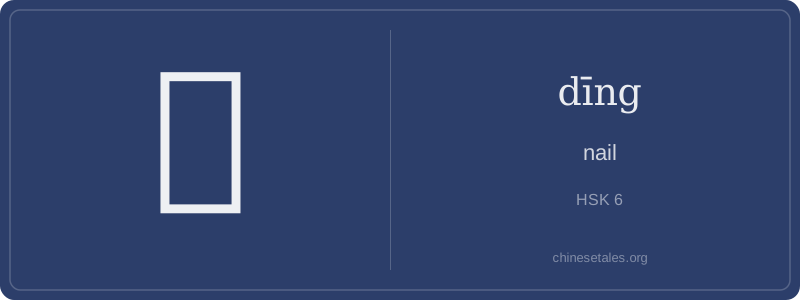
Trace back to oracle bone script (c. 1200 BCE), and 钉 didn’t exist yet — but its ancestor 丁 did: a bold, square glyph resembling a sturdy post or the cross-section of a wooden beam, symbolizing strength and stability. By the Warring States period, scribes added the metal radical 钅 on the left to specify *metal nails*, distinguishing them from wooden pegs (which used different characters). The modern form crystallized in clerical script: seven clean strokes — the vertical stroke of 钅, then the compact, angular 丁 — evoking both the gleam of iron and the unyielding shape of a nail head and shaft.
Early bronze inscriptions show 钉 used in ritual contexts: temple doors were ‘nail-sealed’ (钉闭) to signify divine protection. In the *Zuo Zhuan*, a 5th-century BCE chronicle, 钉 appears in descriptions of armor repair — ‘re-nailing the cuirass’ (重钉甲) implying restoration of integrity. Over centuries, the visual austerity of the character — rigid, symmetrical, unadorned — reinforced its semantic core: something that *holds fast*. Even today, when Chinese speakers say ‘a word is nailed down’ (话钉死了), they invoke that ancient sense of irrevocable finality — no wiggle room, no backing out.
At its core, 钉 (dīng) is a concrete, tactile word — it’s the sharp, metallic *nail* that bites into wood or wall. But don’t let its simplicity fool you: this character is a linguistic chameleon. The left radical 钅 (‘metal’) immediately signals materiality and hardness — no bamboo or silk here! The right side 丁 (dīng), originally a pictograph of a nail-shaped tool or a strong, square shoulder, doubles as both phonetic clue and semantic reinforcement: think ‘stubbornly fixed’ or ‘firmly anchored’. Together, they form a character that feels solid, decisive, even slightly aggressive in tone.
Grammatically, 钉 shines beyond nouns. As a verb (still dīng), it means *to nail down*, *to pin*, or *to fix firmly* — often metaphorically: 钉在墙上 (dīng zài qiáng shàng, ‘nailed to the wall’) can mean literally mounting a poster… or figuratively, ‘being trapped by obligation’. Learners often mistakenly use 钉 for ‘to hammer’ (that’s 捶 or 敲); 钉 is about the *result* — the secure attachment — not the action of striking. Also watch tone: dìng (fourth tone) appears in compounds like 订 (to order) or 钉住 (dìnɡ zhù, ‘to pin down’ in urgent contexts), where the meaning shifts toward binding or locking in place.
Culturally, 钉 carries subtle weight: in classical texts, 钉 was associated with craftsmanship and permanence — Confucius praised rulers who ‘nail down virtue’ (钉德) in governance. Today, internet slang uses 钉 (dīng) playfully: 钉子户 (dīng·zi hù, ‘nail-household’) refers to stubborn holdouts refusing demolition — a vivid, slightly rebellious image. A common learner trap? Overgeneralizing 钉 as ‘to attach’ — remember: it implies force, precision, and irreversibility. Glue? Use 粘. Tape? Use 贴. But if it’s *driven in*, it’s 钉.